庀 (pǐ) means "to prepare; to provide" in Chinese. It has 5 strokes with the radical 广.
Rated 2.9/5 in difficulty (moderate).
Appears in 3+ common words including 庀具 (pǐ jù), 庀工 (pǐ gōng), 庀事 (pǐ shì).
Hanzi Writer's stroke validation shows learners typically need 5-8 attempts to write 庀 with correct proportion and order.
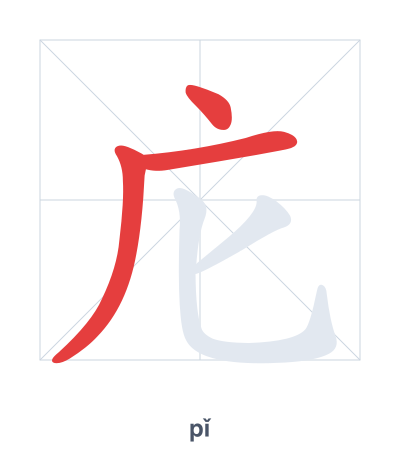
Open Hanzi Writer to see the animated stroke order and practice writing 庀 with real-time feedback.
The character 庀 (pǐ) is written with 5 strokes. Follow the standard Chinese stroke order: top to bottom, left to right, outside before inside. The radical 广 is one of its key components.
Practice the correct stroke order with the Hanzi Writer app to see animated stroke-by-stroke guidance with real-time feedback.
庀 means to prepare; to provide.
庀 combines the radical 广 (a shelter or roof) with 匕 (a spoon or ladle), suggesting the act of preparing or providing utensils and supplies under a roof. The spoon component hints at setting out tools or food, giving the overall sense of making arrangements.
💡 Memory Tip: Picture a host under a wide roof (广) holding a ladle (匕) to dish out food, preparing and providing for guests.
正在庀具待用。
zhèng zài pǐ jù dài yòng
Currently preparing tools for use.
庀工待事。
pǐ gōng dài shì
Workers are organized and waiting for the task.
庀事已毕。
pǐ shì yǐ bì
The preparations are complete.
Open Hanzi Writer to see the animated stroke order and practice writing 庀 with real-time feedback.
✨ Animated stroke order · Handwriting recognition · HSK-graded practice · Free to use
庀 is composed of the radical 广 (a shelter or roof) on top and the component 匕 (a spoon or dagger) below. The shelter represents a workspace, while the spoon/dagger symbolizes tools or utensils, together suggesting the act of preparing or providing tools under a roof.