庇 (bì) means "to shield; to protect" in Chinese. It has 7 strokes with the radical 广.
Rated 3.5/5 in difficulty (challenging).
Appears in 3+ common words including 庇护 (bì hù), 庇佑 (bì yòu), 包庇 (bāo bì).
Due to its 7 strokes, Hanzi Writer's error detection shows 庇 requires focused practice — most learners need 10+ attempts for consistent accuracy.
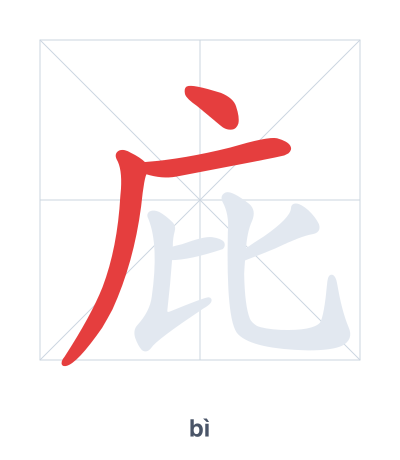
Open Hanzi Writer to see the animated stroke order and practice writing 庇 with real-time feedback.
The character 庇 (bì) is written with 7 strokes. Follow the standard Chinese stroke order: top to bottom, left to right, outside before inside. The radical 广 is one of its key components.
Practice the correct stroke order with the Hanzi Writer app to see animated stroke-by-stroke guidance with real-time feedback.
庇 means to shield; to protect.
庇 combines the shelter radical 广 with 比 (bǐ), which provides sound and also hints at closeness — like a roof covering those side by side, offering protection.
💡 Memory Tip: Picture two people (比) huddled under a roof (广) to shield themselves from a storm.
寻求法律庇护。
xún qiú fǎ lǜ bì hù
Seeking legal protection.
上天庇佑大家。
shàng tiān bì yòu dà jiā
May Heaven protect everyone.
不能包庇坏人。
bù néng bāo bì huài rén
Bad people must not be shielded.
Open Hanzi Writer to see the animated stroke order and practice writing 庇 with real-time feedback.
✨ Animated stroke order · Handwriting recognition · HSK-graded practice · Free to use
庇 combines the radical 广 (a shelter or building) with 比 (two people side by side). The radical 广 provides the meaning of 'shelter,' while 比 hints at the pronunciation 'bì.' Together, the character suggests a roof protecting people, which relates to 'shielding' or 'protecting.'