庋 (guǐ) means "to store; to put away" in Chinese. It has 7 strokes with the radical 广.
Rated 3.5/5 in difficulty (challenging).
Appears in 3+ common words including 庋藏 (guǐ cáng), 庋架 (guǐ jià), 庋置 (guǐ zhì).
Due to its 7 strokes, Hanzi Writer's error detection shows 庋 requires focused practice — most learners need 10+ attempts for consistent accuracy.
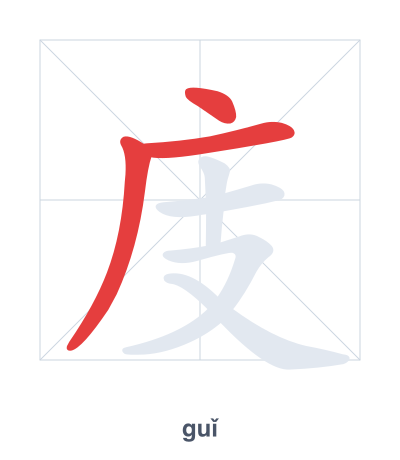
Open Hanzi Writer to see the animated stroke order and practice writing 庋 with real-time feedback.
The character 庋 (guǐ) is written with 7 strokes. Follow the standard Chinese stroke order: top to bottom, left to right, outside before inside. The radical 广 is one of its key components.
Practice the correct stroke order with the Hanzi Writer app to see animated stroke-by-stroke guidance with real-time feedback.
庋 means to store; to put away.
庋 is a phono-semantic compound where the radical 广 (a roof or shelter) indicates a place for storage, and the component 支 (zhī, meaning 'branch' or 'to support') hints at the sound guǐ while also evoking the idea of a shelf or rack that supports stored items.
💡 Memory Tip: Imagine a roof (广) over a shelf supported by a branch (支) where you store away your things.
他有很多艺术庋藏。
tā yǒu hěn duō yì shù guǐ cáng
He has many art collections.
书放在庋架上。
shū fàng zài guǐ jià shàng
The book is placed on the storage shelf.
旧物被庋置在角落。
jiù wù bèi guǐ zhì zài jiǎo luò
Old items were stored away in the corner.
Open Hanzi Writer to see the animated stroke order and practice writing 庋 with real-time feedback.
✨ Animated stroke order · Handwriting recognition · HSK-graded practice · Free to use
庋 is made of the radical 广 (a shelter or house) and the phonetic component 支 (zhī). The radical suggests a building or storage space, while 支 hints at the sound. Together, they form the idea of storing things away in a sheltered place.