壅 (yōng) means "block up" in Chinese. It has 16 strokes with the radical 土.
Rated 4.2/5 in difficulty (advanced).
Appears in 3+ common words including 壅土 (yōng tǔ), 壅塞 (yōng sè), 壅水 (yōng shuǐ).
Due to its 16 strokes, Hanzi Writer's error detection shows 壅 requires focused practice — most learners need 10+ attempts for consistent accuracy.
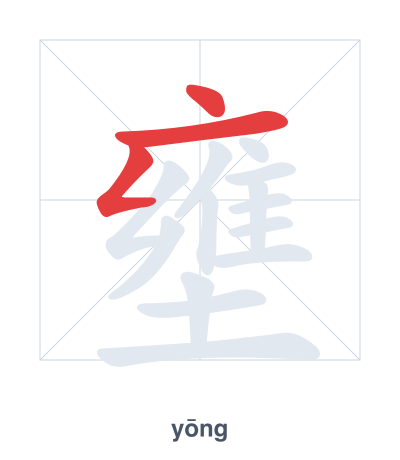
Open Hanzi Writer to see the animated stroke order and practice writing 壅 with real-time feedback.
The character 壅 (yōng) is written with 16 strokes. Follow the standard Chinese stroke order: top to bottom, left to right, outside before inside. The radical 土 is one of its key components.
Practice the correct stroke order with the Hanzi Writer app to see animated stroke-by-stroke guidance with real-time feedback.
壅 means block up.
壅 is a phono-semantic compound: the radical 土 (earth) hints at blocking with soil, while the phonetic component 雍 (yōng, meaning 'harmony') provides pronunciation. In ancient contexts, building up earth mounds was a way to block or obstruct paths, linking the visual of soil (土) with the concept of obstruction.
💡 Memory Tip: Imagine a harmonious bird (雍) trying to fly but getting its feet stuck in thick mud (土), effectively blocking its movement.
给花壅点儿土吧。
gěi huā yōng diǎn ér tǔ ba
Mound some soil around the flowers.
河道被泥沙壅塞了。
hé dào bèi ní shā yōng sè le
The river channel is blocked by silt and sand.
农民在田里壅水。
nóng mín zài tián lǐ yōng shuǐ
Farmers are damming water in the field.
Open Hanzi Writer to see the animated stroke order and practice writing 壅 with real-time feedback.
✨ Animated stroke order · Handwriting recognition · HSK-graded practice · Free to use
壅 is composed of the radical 土 (earth) on the left and the phonetic component 雍 (yōng) on the right. The radical 土 directly suggests the meaning involves soil or earth, while 雍 originally carried the sense of crowding or blocking. Together, they form the idea of using earth to block up a passage.