媵 (yìng) means "concubine; maidservant accompanying a bride" in Chinese. It has 13 strokes with the radical 女.
Rated 4.2/5 in difficulty (advanced).
Appears in 3+ common words including 媵侍 (yìng shì), 媵妾 (yìng qiè), 陪媵 (péi yìng).
Due to its 13 strokes, Hanzi Writer's error detection shows 媵 requires focused practice — most learners need 10+ attempts for consistent accuracy.
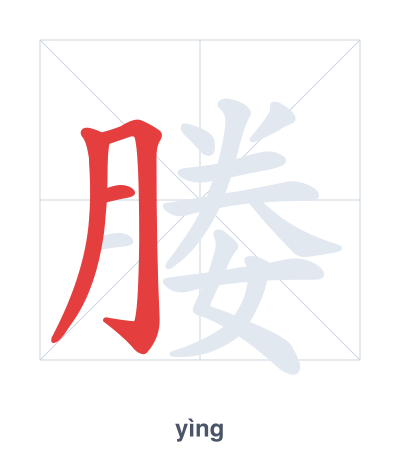
Open Hanzi Writer to see the animated stroke order and practice writing 媵 with real-time feedback.
The character 媵 (yìng) is written with 13 strokes. Follow the standard Chinese stroke order: top to bottom, left to right, outside before inside. The radical 女 is one of its key components.
Practice the correct stroke order with the Hanzi Writer app to see animated stroke-by-stroke guidance with real-time feedback.
媵 means concubine; maidservant accompanying a bride.
媵 combines the radical 女 (woman) with 朕 (zhèn). The right component 朕 originally depicted a boat (舟) and split wood (灷), suggesting a woman accompanying a bride on a journey as a concubine or maidservant.
💡 Memory Tip: Imagine a woman (女) on a boat (the 月 part of 朕) carrying firewood (the 关 part) as she serves the bride on her wedding journey.
古代宫廷中有媵侍。
gǔ dài gōng tíng zhōng yǒu yìng shì
There were concubine-attendants in ancient courts.
她是王妃的媵妾。
tā shì wáng fēi de yìng qiè
She is the princess's handmaid-concubine.
陪媵是古代的习俗。
péi yìng shì gǔ dài de xí sú
Accompanying concubines was an ancient custom.
Open Hanzi Writer to see the animated stroke order and practice writing 媵 with real-time feedback.
✨ Animated stroke order · Handwriting recognition · HSK-graded practice · Free to use
媵 is composed of the radical 女 (woman) on the left, which hints at its female-related meaning, and the phonetic component 朕 on the right, which provides the sound yuè (but here it is modified to yìng). The combination suggests a woman who serves or accompanies, like a maidservant or concubine accompanying a bride in ancient customs.