妾 (qiè) means "Concubine." in Chinese. It has 8 strokes with the radical 女.
Rated 3.7/5 in difficulty (challenging).
Appears in 3+ common words including 纳妾 (nà qiè), 妻妾 (qī qiè), 臣妾 (chén qiè).
Due to its 8 strokes, Hanzi Writer's error detection shows 妾 requires focused practice — most learners need 10+ attempts for consistent accuracy.
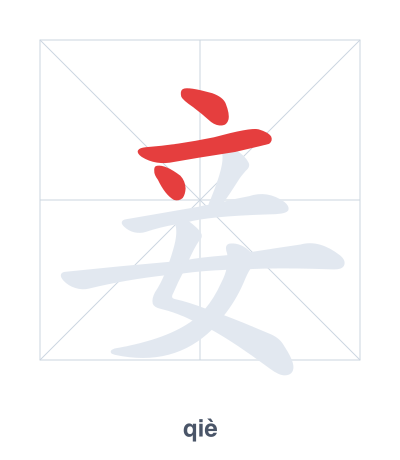
Open Hanzi Writer to see the animated stroke order and practice writing 妾 with real-time feedback.
The character 妾 (qiè) is written with 8 strokes. Follow the standard Chinese stroke order: top to bottom, left to right, outside before inside. The radical 女 is one of its key components.
Practice the correct stroke order with the Hanzi Writer app to see animated stroke-by-stroke guidance with real-time feedback.
妾 means Concubine..
妾 combines 立 (standing) and 女 (woman). In ancient script, the top component originally depicted a branding mark (from 辛), indicating a woman in a subservient or enslaved role—hence a concubine.
💡 Memory Tip: Picture a woman (女) standing (立) obediently with a brand on her forehead, a concubine waiting for her master.
古代男人可以纳妾。
gǔ dài nán rén kě yǐ nà qiè
Ancient men could take concubines.
他有很多妻妾。
tā yǒu hěn duō qī qiè
He has many wives and concubines.
臣妾做不到。
chén qiè zuò bú dào
I (your servant) cannot do it.
Open Hanzi Writer to see the animated stroke order and practice writing 妾 with real-time feedback.
✨ Animated stroke order · Handwriting recognition · HSK-graded practice · Free to use
The character 妾 is made of two parts: 立 (to stand) on top and 女 (woman) below. Together they suggest a woman who stands or serves, reflecting the historical role of a concubine as a woman of lower status in a household.