垠 (yín) means "boundary; limit" in Chinese. It has 9 strokes with the radical 土.
Rated 4/5 in difficulty (challenging).
Appears in 3+ common words including 无垠 (wú yín), 边垠 (biān yín), 垠际 (yín jì).
Due to its 9 strokes, Hanzi Writer's error detection shows 垠 requires focused practice — most learners need 10+ attempts for consistent accuracy.
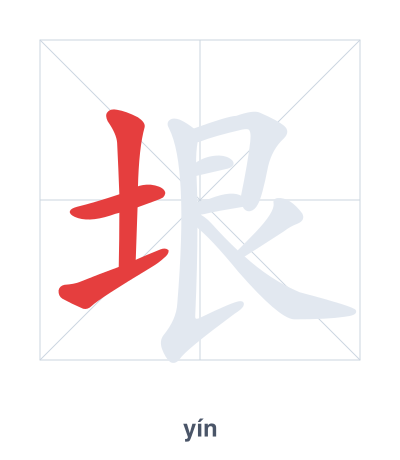
Open Hanzi Writer to see the animated stroke order and practice writing 垠 with real-time feedback.
The character 垠 (yín) is written with 9 strokes. Follow the standard Chinese stroke order: top to bottom, left to right, outside before inside. The radical 土 is one of its key components.
Practice the correct stroke order with the Hanzi Writer app to see animated stroke-by-stroke guidance with real-time feedback.
垠 means boundary; limit.
垠 is a phono-semantic compound combining the radical 土 (earth, representing physical land) with 艮 (gèn, meaning 'stop' or 'firm'). Together, they depict an earthen barrier that marks where something ends, hence 'boundary' or 'limit'. The component 艮 also provides phonetic value similar to yín.
💡 Memory Tip: Picture a line of earth (土) with a stop sign (艮) planted on it, telling you this is the boundary—you can go no further.
大海一望无垠。
dà hǎi yí wàng wú yín
The sea stretches as far as the eye can see.
这个草原没有边垠。
zhè ge cǎo yuán méi yǒu biān yín
This grassland is boundless.
天空广阔无垠际。
tiān kōng guǎng kuò wú yín jì
The sky is vast and boundless.
Open Hanzi Writer to see the animated stroke order and practice writing 垠 with real-time feedback.
✨ Animated stroke order · Handwriting recognition · HSK-graded practice · Free to use
垠 is composed of the radical 土 (earth) on the left and 艮 (gèn, meaning "tough" or "stop") on the right. The earth radical suggests a physical boundary made of soil, while 艮 implies a stopping point. Together, they convey the idea of a limit or edge defined by land.