际 (jì) means "border / edge / between" in Chinese. It has 7 strokes with the radical 阝, and is HSK Level 2.
Rated 2.7/5 in difficulty (moderate).
Harder than 31% of HSK Level 2 characters.
Appears in 3+ common words including 国际 (guó jì), 实际 (shí jì), 交际 (jiāo jì).
Hanzi Writer's stroke validation shows learners typically need 5-8 attempts to write 际 with correct proportion and order.
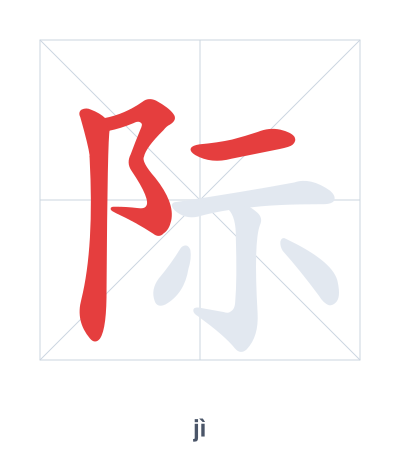
Open Hanzi Writer to see the animated stroke order and practice writing 际 with real-time feedback.
The character 际 (jì) is written with 7 strokes. Follow the standard Chinese stroke order: top to bottom, left to right, outside before inside. The radical 阝 is one of its key components.
Practice the correct stroke order with the Hanzi Writer app to see animated stroke-by-stroke guidance with real-time feedback.
际 means border / edge / between.
As an HSK Level 2 character, 际 is among the first characters beginners learn.
This compound character combines the left radical 阝 (mound or place) with the right part 示 (altar or spirit). In ancient times, altars or stone markers were placed on hills to delineate borders, so 际 came to mean 'border' or 'edge'—the line where one territory meets another.
💡 Memory Tip: Picture a hill (阝) with an altar (示) perched right on the edge of a cliff, marking the boundary between land and sky.
他在国际学校。
tā zài guó jì xué xiào
He is at an international school.
实际情况很复杂。
shí jì qíng kuàng hěn fù zá
The actual situation is very complex.
他的交际能力强。
tā de jiāo jì néng lì qiáng
He has strong social skills.
Open Hanzi Writer to see the animated stroke order and practice writing 际 with real-time feedback.
✨ Animated stroke order · Handwriting recognition · HSK-graded practice · Free to use
际 has two parts: the radical 阝 (which comes from 阜 meaning 'mound' or 'hill') on the left, and 示 (meaning 'show' or 'sign') on the right. The hill radical suggests a boundary or edge, while 示 adds the idea of indicating a limit, together forming the meaning 'border' or 'between'.