癔 (yì) means "hysteria" in Chinese. It has 18 strokes with the radical 疒.
Rated 4.2/5 in difficulty (advanced).
Appears in 3+ common words including 癔病 (yì bìng), 癔症 (yì zhèng), 癔语 (yì yǔ).
Due to its 18 strokes, Hanzi Writer's error detection shows 癔 requires focused practice — most learners need 10+ attempts for consistent accuracy.
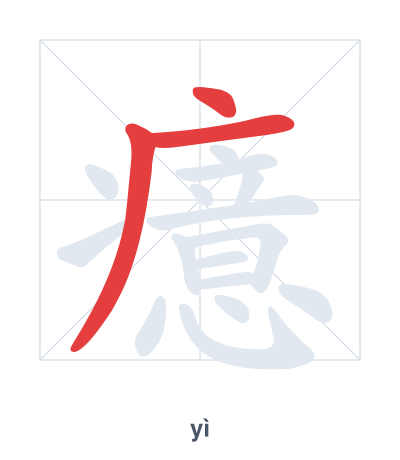
Open Hanzi Writer to see the animated stroke order and practice writing 癔 with real-time feedback.
The character 癔 (yì) is written with 18 strokes. Follow the standard Chinese stroke order: top to bottom, left to right, outside before inside. The radical 疒 is one of its key components.
Practice the correct stroke order with the Hanzi Writer app to see animated stroke-by-stroke guidance with real-time feedback.
癔 means hysteria.
The character 癔 combines the radical 疒 (illness) with 意 (meaning/thought), indicating a disease of the mind where one's thoughts or meanings become disordered—hence hysteria.
💡 Memory Tip: Picture a sick person (疒) whose heart (心, bottom of 意) is overwhelmed by a loud noise (音, top of 意), causing a hysterical fit.
这种病叫癔病。
zhè zhǒng bìng jiào yì bìng
This disease is called hysteria.
她得了癔症。
tā dé le yì zhèng
She suffered from hysteria.
他在说癔语。
tā zài shuō yì yǔ
He is talking deliriously.
Open Hanzi Writer to see the animated stroke order and practice writing 癔 with real-time feedback.
✨ Animated stroke order · Handwriting recognition · HSK-graded practice · Free to use
The character 癔 is made of the radical 疒 (illness) on top, and the component 意 (meaning or idea) underneath. Together, they suggest a mental or psychological illness linked to ideas or emotions. This structure directly relates to the meaning of hysteria, which is a disorder of the mind or emotions.