椰 (yē) means "Coconut" in Chinese. It has 12 strokes with the radical 木, and is HSK Level 7.
Rated 4.2/5 in difficulty (advanced).
Harder than 64% of HSK Level 7 characters.
Appears in 3+ common words including 椰子 (yē zi), 椰奶 (yē nǎi), 椰蓉 (yē róng).
Due to its 12 strokes, Hanzi Writer's error detection shows 椰 requires focused practice — most learners need 10+ attempts for consistent accuracy.
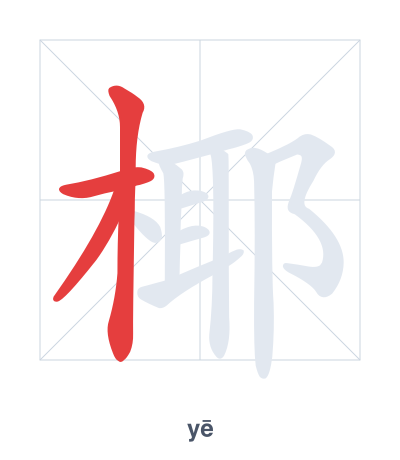
Open Hanzi Writer to see the animated stroke order and practice writing 椰 with real-time feedback.
The character 椰 (yē) is written with 12 strokes. Follow the standard Chinese stroke order: top to bottom, left to right, outside before inside. The radical 木 is one of its key components.
Practice the correct stroke order with the Hanzi Writer app to see animated stroke-by-stroke guidance with real-time feedback.
椰 means Coconut.
As an HSK Level 7 character, 椰 is an intermediate-level character.
椰 is a semantic-phonetic compound: the left radical 木 (tree) indicates it's a type of tree, while the right component 耶 (yē) provides the pronunciation and originally depicted a father holding a stick, but here it simply serves as a phonetic hint. Coconuts grow on palm trees, so the 'wood' radical connects the character to its meaning.
💡 Memory Tip: Imagine a coconut tree (木) with a funny face on the coconut that looks like the right side 耶—the two big eyes and mouth are saying 'Yē-ah!' as you crack it open.
我喜欢喝椰子水。
wǒ xǐ huān hē yē zi shuǐ
I like drinking coconut water.
这种甜点里有椰奶。
zhè zhǒng tián diǎn lǐ yǒu yē nǎi
This dessert contains coconut milk.
面包上面撒了椰蓉。
miàn bāo shàng miàn sā le yē róng
The bread is sprinkled with shredded coconut.
Open Hanzi Writer to see the animated stroke order and practice writing 椰 with real-time feedback.
✨ Animated stroke order · Handwriting recognition · HSK-graded practice · Free to use
椰 combines the radical 木 (tree/wood) on the left with the phonetic component 耶 (yē) on the right. The 木 radical indicates the character relates to a tree or plant, which matches the coconut palm. The right side gives a clue to the pronunciation, yē.