蓉 (róng) means "Hibiscus" in Chinese. It has 13 strokes with the radical 艹.
Rated 4.2/5 in difficulty (advanced).
Appears in 3+ common words including 芙蓉 (fú róng), 椰蓉 (yē róng), 蓉城 (róng chéng).
Due to its 13 strokes, Hanzi Writer's error detection shows 蓉 requires focused practice — most learners need 10+ attempts for consistent accuracy.
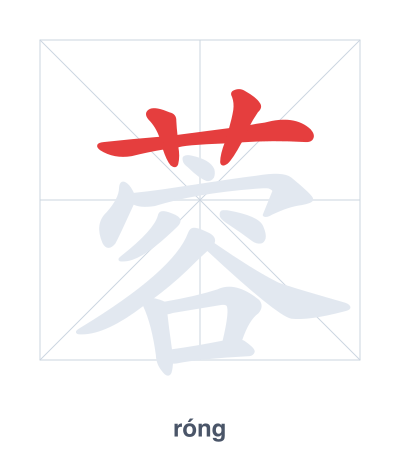
Open Hanzi Writer to see the animated stroke order and practice writing 蓉 with real-time feedback.
The character 蓉 (róng) is written with 13 strokes. Follow the standard Chinese stroke order: top to bottom, left to right, outside before inside. The radical 艹 is one of its key components.
Practice the correct stroke order with the Hanzi Writer app to see animated stroke-by-stroke guidance with real-time feedback.
蓉 means Hibiscus.
蓉 is a phono-semantic compound: the radical 艹 (grass/plant) indicates it is a type of plant, while 容 (róng) provides the pronunciation and also hints at the flower's shape—like a container (容) holding broad, showy petals, as hibiscus blossoms are cup-like.
💡 Memory Tip: Picture a hibiscus plant (艹) whose bloom opens wide like a container (容) to catch rain, with the flower's face (容) smiling.
芙蓉花在秋天开放。
fú róng huā zài qiū tiān kāi fàng
Hibiscus flowers bloom in autumn.
我喜欢吃椰蓉面包。
wǒ xǐ huān chī yē róng miàn bāo
I like eating coconut bread.
成都也被人们称为蓉城。
chéng dū yě bèi rén men chēng wéi róng chéng
Chengdu is also known as the City of Hibiscus.
Open Hanzi Writer to see the animated stroke order and practice writing 蓉 with real-time feedback.
✨ Animated stroke order · Handwriting recognition · HSK-graded practice · Free to use
蓉 is made of the grass radical 艹 on top and the phonetic component 容 (róng, meaning 'to contain') below. The grass radical indicates that 蓉 refers to a type of plant, specifically the hibiscus flower. So the character combines 'plant' with a sound hint to mean 'hibiscus'.