艳 (yàn) means "gorgeous; bright; colorful" in Chinese. It has 10 strokes with the radical 色, and is HSK Level 5.
Rated 4.2/5 in difficulty (advanced).
Harder than 90% of HSK Level 5 characters.
Appears in 3+ common words including 鲜艳 (xiān yàn), 艳丽 (yàn lì), 艳阳 (yàn yáng).
Due to its 10 strokes, Hanzi Writer's error detection shows 艳 requires focused practice — most learners need 10+ attempts for consistent accuracy.
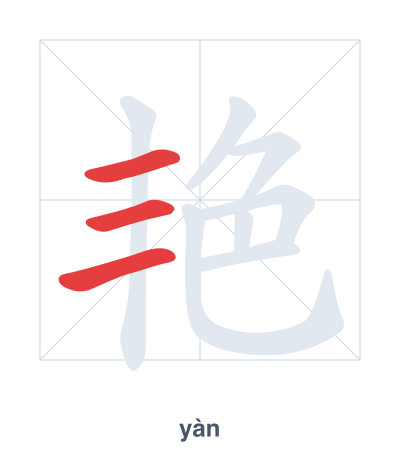
Open Hanzi Writer to see the animated stroke order and practice writing 艳 with real-time feedback.
The character 艳 (yàn) is written with 10 strokes. Follow the standard Chinese stroke order: top to bottom, left to right, outside before inside. The radical 色 is one of its key components.
Practice the correct stroke order with the Hanzi Writer app to see animated stroke-by-stroke guidance with real-time feedback.
艳 means gorgeous; bright; colorful.
As an HSK Level 5 character, 艳 is an intermediate-level character.
The simplified character 艳 combines the left component 丰 (meaning 'abundant' or 'lush', originally a pictograph of a plant with full leaves) with the right radical 色 (meaning 'color'). Together, the form suggests 'abundant color' or 'full of color,' which directly conveys the meaning of gorgeous, bright, and colorful.
💡 Memory Tip: Imagine a lush, overflowing plant (丰) bursting with every vibrant color (色) of the rainbow—so dazzling that it's the most gorgeous sight you've ever seen.
这朵花的颜色很鲜艳。
zhè duǒ huā de yán sè hěn xiān yàn
The color of this flower is very vibrant.
她的衣服非常艳丽。
tā de yī fú fēi cháng yàn lì
Her clothes are very bright and colorful.
今天是一个艳阳天。
jīn tiān shì yí gè yàn yáng tiān
Today is a bright sunny day.
Open Hanzi Writer to see the animated stroke order and practice writing 艳 with real-time feedback.
✨ Animated stroke order · Handwriting recognition · HSK-graded practice · Free to use
The left side is 丰 (fēng), meaning abundant or plentiful, and the right side is 色 (sè), meaning color. Together, they suggest "abundant color," which matches the meaning of gorgeous and bright. However, note that 丰 here is a phonetic component indicating the pronunciation yàn, not the character for "abundant" itself.