沿 (yán) means "Along; to follow" in Chinese. It has 8 strokes with the radical 氵, and is HSK Level 6.
Rated 3.7/5 in difficulty (challenging).
Harder than 31% of HSK Level 6 characters.
Appears in 3+ common words including 沿着 (yán zhe), 沿海 (yán hǎi), 沿途 (yán tú).
Due to its 8 strokes, Hanzi Writer's error detection shows 沿 requires focused practice — most learners need 10+ attempts for consistent accuracy.
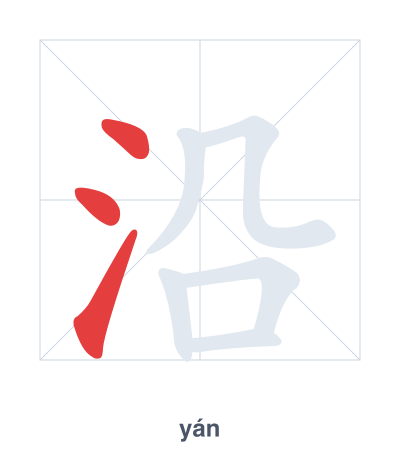
Open Hanzi Writer to see the animated stroke order and practice writing 沿 with real-time feedback.
The character 沿 (yán) is written with 8 strokes. Follow the standard Chinese stroke order: top to bottom, left to right, outside before inside. The radical 氵 is one of its key components.
Practice the correct stroke order with the Hanzi Writer app to see animated stroke-by-stroke guidance with real-time feedback.
沿 means Along; to follow.
As an HSK Level 6 character, 沿 is an intermediate-level character.
沿 combines the water radical (氵) with a component that originally depicted a riverbank or a path beside water, together suggesting moving or extending alongside a waterway, leading to the meaning 'along' or 'to follow.'
💡 Memory Tip: Picture a river (氵) and a little stick figure (the right side resembling a person) walking along its edge, following the flow.
沿着这条路走。
yán zhe zhè tiáo lù zǒu
Walk along this road.
他住在沿海城市。
tā zhù zài yán hǎi chéng shì
He lives in a coastal city.
沿途风景很美。
yán tú fēng jǐng hěn měi
The scenery along the way is beautiful.
Open Hanzi Writer to see the animated stroke order and practice writing 沿 with real-time feedback.
✨ Animated stroke order · Handwriting recognition · HSK-graded practice · Free to use
沿 consists of the radical 氵 (water) on the left and the phonetic component 㕣 on the right. The water radical hints at a connection to rivers or paths, while 㕣 originally meant a stream, together showing the idea of following a watercourse.