揠 (yà) means "to pull up" in Chinese. It has 12 strokes with the radical 扌.
Rated 4.2/5 in difficulty (advanced).
Appears in 3+ common words including 揠苗助长 (yà miáo zhù zhǎng), 揠起 (yà qǐ), 揠苗 (yà miáo).
Due to its 12 strokes, Hanzi Writer's error detection shows 揠 requires focused practice — most learners need 10+ attempts for consistent accuracy.
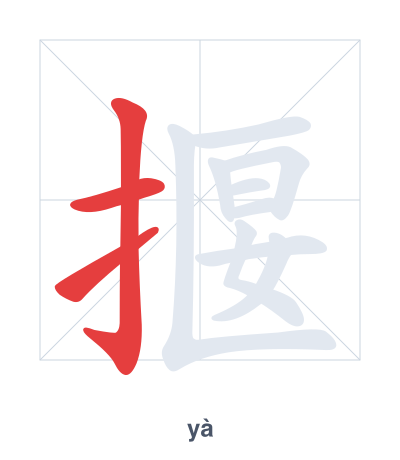
Open Hanzi Writer to see the animated stroke order and practice writing 揠 with real-time feedback.
The character 揠 (yà) is written with 12 strokes. Follow the standard Chinese stroke order: top to bottom, left to right, outside before inside. The radical 扌 is one of its key components.
Practice the correct stroke order with the Hanzi Writer app to see animated stroke-by-stroke guidance with real-time feedback.
揠 means to pull up.
揠 is a compound character where the left radical 扌 (hand) indicates an action performed by hand, and the right component 匽 provides phonetic cues while also vaguely suggesting a plant being bent or pressed. Together, they convey the meaning 'to pull up,' as in yanking a plant from the soil.
💡 Memory Tip: Picture a hand (扌) yanking a plant so hard that a woman (女) under the sun (日) inside a box (匚) screams in surprise.
学习不能揠苗助长。
xué xí bù néng yà miáo zhù zhǎng
One should not try to force progress in learning.
他把小草揠起来了。
tā bǎ xiǎo cǎo yà qǐ lái le
He pulled up the grass.
他在田里揠苗。
tā zài tián lǐ yà miáo
He is pulling up seedlings to help them grow.
Open Hanzi Writer to see the animated stroke order and practice writing 揠 with real-time feedback.
✨ Animated stroke order · Handwriting recognition · HSK-graded practice · Free to use
揠 is made of the hand radical 扌 on the left and the component 匽 on the right. The hand radical shows that the action involves the hands, and the whole character means "to pull up" – like pulling plants out of the ground.