蓄 (xù) means "To store or save" in Chinese. It has 13 strokes with the radical 艹, and is HSK Level 7.
Rated 4.2/5 in difficulty (advanced).
Harder than 87% of HSK Level 7 characters.
Appears in 3+ common words including 储蓄 (chǔ xù), 蓄水 (xù shuǐ), 蓄发 (xù fà).
Due to its 13 strokes, Hanzi Writer's error detection shows 蓄 requires focused practice — most learners need 10+ attempts for consistent accuracy.
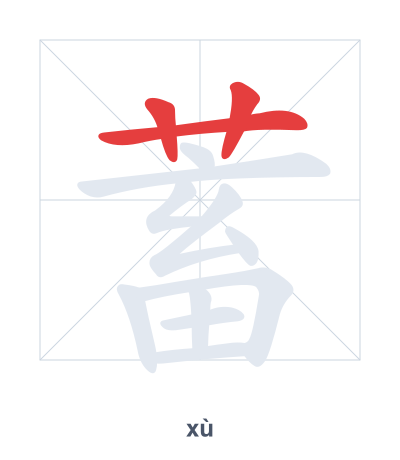
Open Hanzi Writer to see the animated stroke order and practice writing 蓄 with real-time feedback.
The character 蓄 (xù) is written with 13 strokes. Follow the standard Chinese stroke order: top to bottom, left to right, outside before inside. The radical 艹 is one of its key components.
Practice the correct stroke order with the Hanzi Writer app to see animated stroke-by-stroke guidance with real-time feedback.
蓄 means To store or save.
As an HSK Level 7 character, 蓄 is an intermediate-level character.
蓄 combines the grass radical 艹 (plants) with 畜 (xù, livestock), suggesting the accumulation of fodder for animals. Originally it meant to store up hay or grain, later expanding to any kind of saving or stockpiling.
💡 Memory Tip: Picture a farmer piling grass (艹) into a huge bin (the 畜 part) to store it for winter feed.
我每个月都会去银行储蓄。
wǒ měi gè yuè dū huì qù yín háng chǔ xù
I save money at the bank every month.
这个水库正在蓄水。
zhè ge shuǐ kù zhèng zài xù shuǐ
This reservoir is storing water.
他决定从今年开始蓄发。
tā jué dìng cóng jīn nián kāi shǐ xù fà
He decided to start growing his hair out this year.
Open Hanzi Writer to see the animated stroke order and practice writing 蓄 with real-time feedback.
✨ Animated stroke order · Handwriting recognition · HSK-graded practice · Free to use
蓄 has three parts: 艹 (grass) on top, 彐 (a hand or pig snout) in the middle, and 田 (field) at the bottom. The grass and field suggest growing things that can be stored, while the middle part hints at gathering or keeping. Together they create the idea of storing resources like water or savings.