嘘 (xū) means "Shh / To hiss / To sigh" in Chinese. It has 14 strokes with the radical 口.
Rated 4.2/5 in difficulty (advanced).
Appears in 3+ common words including 嘘声 (xū shēng), 嘘寒问暖 (xū hán wèn nuǎn), 嘘一声 (xū yī shēng).
Due to its 14 strokes, Hanzi Writer's error detection shows 嘘 requires focused practice — most learners need 10+ attempts for consistent accuracy.
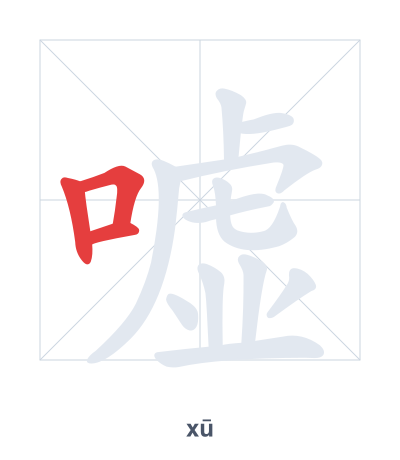
Open Hanzi Writer to see the animated stroke order and practice writing 嘘 with real-time feedback.
The character 嘘 (xū) is written with 14 strokes. Follow the standard Chinese stroke order: top to bottom, left to right, outside before inside. The radical 口 is one of its key components.
Practice the correct stroke order with the Hanzi Writer app to see animated stroke-by-stroke guidance with real-time feedback.
嘘 means Shh / To hiss / To sigh.
The character 嘘 combines the mouth radical 口 with the phonetic component 虚 (xū, meaning 'empty' or 'hollow'). Together, they depict the act of exhaling empty air through the mouth, producing a hissing or sighing sound, or a 'shh' to demand silence.
💡 Memory Tip: Picture a mouth (口) blowing out an empty, hollow sound (虚) as if saying 'Shhh!' to quiet a crowd.
现场传出嘘声。
xiàn chǎng chuán chū xū shēng
Boos were heard from the scene.
他对我嘘寒问暖。
tā duì wǒ xū hán wèn nuǎn
He showed great concern for my well-being.
请嘘一声。
qǐng xū yī shēng
Please say 'shh'.
Open Hanzi Writer to see the animated stroke order and practice writing 嘘 with real-time feedback.
✨ Animated stroke order · Handwriting recognition · HSK-graded practice · Free to use
The character 嘘 is composed of the radical 口 (mouth) on the left, and the phonetic component 虚 on the right. The mouth radical indicates that the character relates to sounds made by the mouth, while 虚 (meaning empty or hollow) hints at the soft, breathy nature of a shushing sound or sigh. Together, the structure suggests a sound produced from an empty mouth — like a quiet 'shh'.