邂 (xiè) means "to meet unexpectedly" in Chinese. It has 16 strokes with the radical 辶.
Rated 4.2/5 in difficulty (advanced).
Appears in 3+ common words including 邂逅 (xiè hòu), 邂逅相遇 (xiè hòu xiāng yù), 美丽邂逅 (měi lì xiè hòu).
Due to its 16 strokes, Hanzi Writer's error detection shows 邂 requires focused practice — most learners need 10+ attempts for consistent accuracy.
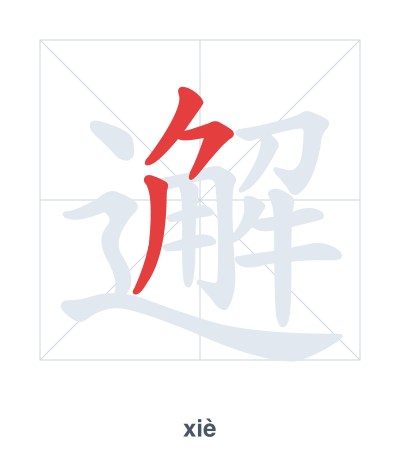
Open Hanzi Writer to see the animated stroke order and practice writing 邂 with real-time feedback.
The character 邂 (xiè) is written with 16 strokes. Follow the standard Chinese stroke order: top to bottom, left to right, outside before inside. The radical 辶 is one of its key components.
Practice the correct stroke order with the Hanzi Writer app to see animated stroke-by-stroke guidance with real-time feedback.
邂 means to meet unexpectedly.
The character 邂 combines the radical 辶 (walking) with 解 (to untie, separate), suggesting an unplanned meeting where paths cross and untether freely. Originally part of the compound 邂逅, it describes a chance encounter as if two journeys momentarily loosen their separate courses.
💡 Memory Tip: Picture yourself walking (辶) and accidentally stepping on a loose lace (解), causing you to trip and unexpectedly meet the person in front of you.
我在路口邂逅了她。
wǒ zài lù kǒu xiè hòu le tā
I met her by chance at the intersection.
两人在书店邂逅相遇。
liǎng rén zài shū diàn xiè hòu xiāng yù
The two met by chance in the bookstore.
这是一次美丽的邂逅。
zhè shì yī cì měi lì de xiè hòu
This is a beautiful encounter.
Open Hanzi Writer to see the animated stroke order and practice writing 邂 with real-time feedback.
✨ Animated stroke order · Handwriting recognition · HSK-graded practice · Free to use
The character 邂 combines the radical 辶 (walking) with the component 解 (to untie or separate). The walking radical suggests movement, while 解 implies something that becomes undone or unplanned, together meaning an unplanned meeting while on the move.