逅 (hòu) means "to meet unexpectedly" in Chinese. It has 9 strokes with the radical 辶.
Rated 4/5 in difficulty (challenging).
Appears in 3+ common words including 邂逅 (xiè hòu), 偶然邂逅 (ǒu rán xiè hòu), 邂逅相遇 (xiè hòu xiāng yù).
Due to its 9 strokes, Hanzi Writer's error detection shows 逅 requires focused practice — most learners need 10+ attempts for consistent accuracy.
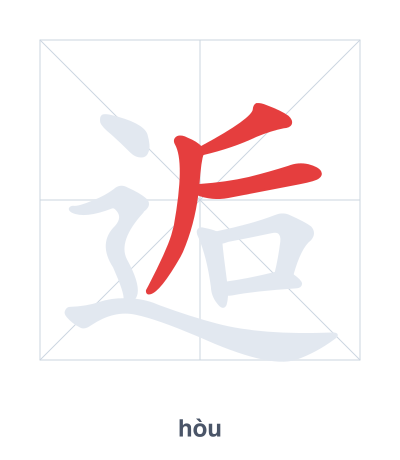
Open Hanzi Writer to see the animated stroke order and practice writing 逅 with real-time feedback.
The character 逅 (hòu) is written with 9 strokes. Follow the standard Chinese stroke order: top to bottom, left to right, outside before inside. The radical 辶 is one of its key components.
Practice the correct stroke order with the Hanzi Writer app to see animated stroke-by-stroke guidance with real-time feedback.
逅 means to meet unexpectedly.
逅 is a compound character. The radical 辶 (walk) indicates movement, while 后 (behind/after) suggests a temporal or spatial sequence. Together, they evoke the idea of meeting after walking, implying an encounter that happens by chance or unexpectedly.
💡 Memory Tip: Picture yourself walking (辶) around a corner and suddenly bumping into someone who was right behind (后) you—an unexpected meeting!
我们在书店邂逅了。
wǒ men zài shū diàn xiè hòu le
We met by chance in the bookstore.
这是一次偶然的邂逅。
zhè shì yī cì ǒu rán de xiè hòu
This is a chance encounter.
两人在公园里邂逅相遇。
liǎng rén zài gōng yuán lǐ xiè hòu xiāng yù
The two met by chance in the park.
Open Hanzi Writer to see the animated stroke order and practice writing 逅 with real-time feedback.
✨ Animated stroke order · Handwriting recognition · HSK-graded practice · Free to use
The character 逅 is composed of the radical 辶 (walk) on the left, and the phonetic component 后 (hòu, meaning 'behind' or 'after') on the right. Together, they suggest the idea of walking and then encountering someone from behind, which matches the meaning 'to meet unexpectedly'.