豚 (tún) means "Piglet" in Chinese. It has 11 strokes with the radical 豕.
Rated 4.2/5 in difficulty (advanced).
Appears in 3+ common words including 海豚 (hǎi tún), 河豚 (hé tún), 豚肉 (tún ròu).
Due to its 11 strokes, Hanzi Writer's error detection shows 豚 requires focused practice — most learners need 10+ attempts for consistent accuracy.
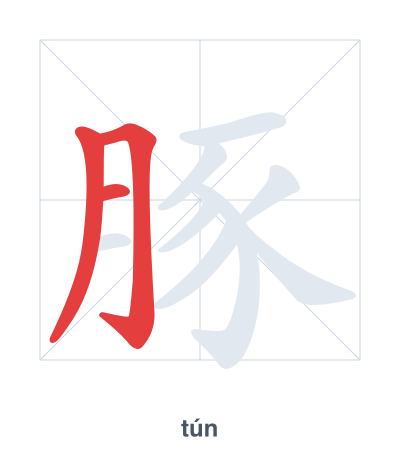
Open Hanzi Writer to see the animated stroke order and practice writing 豚 with real-time feedback.
The character 豚 (tún) is written with 11 strokes. Follow the standard Chinese stroke order: top to bottom, left to right, outside before inside. The radical 豕 is one of its key components.
Practice the correct stroke order with the Hanzi Writer app to see animated stroke-by-stroke guidance with real-time feedback.
豚 means Piglet.
| Character | 豚 |
| Pinyin | tún (tun) |
| Meaning | Piglet |
| Strokes | 11 |
| Radical | 豕 |
| Difficulty | 4.2/5 |
The character 豚 combines 豕 (pig) and 月 (a variant of 肉, meaning flesh/meat), indicating a young pig raised for its tender meat. In ancient forms, it was a compound emphasizing the piglet's plump, meaty body.
💡 Memory Tip: Picture a pig (豕) with a belly round like the moon (月) — that's a chubby piglet.
海豚非常聪明。
hǎi tún fēi cháng cōng míng
Dolphins are very intelligent.
河豚的味道很鲜美。
hé tún de wèi dào hěn xiān měi
Pufferfish tastes very delicious.
这种豚肉很好吃。
zhè zhǒng tún ròu hěn hǎo chī
This pork is delicious.
Open Hanzi Writer to see the animated stroke order and practice writing 豚 with real-time feedback.
✨ Animated stroke order · Handwriting recognition · HSK-graded practice · Free to use
豚 is composed of the radical 豕 (pig) on the left and 屯 (tún, meaning "to gather" or "village") on the right. The left part directly shows a pig, and the right part gives a phonetic hint for the pronunciation. Together, they represent a young pig or piglet.