嘻 (xī) means "hehe; giggling sound" in Chinese. It has 15 strokes with the radical 口.
Rated 4.2/5 in difficulty (advanced).
Appears in 3+ common words including 嘻嘻 (xī xī), 嘻哈 (xī hā), 笑嘻嘻 (xiào xī xī).
Due to its 15 strokes, Hanzi Writer's error detection shows 嘻 requires focused practice — most learners need 10+ attempts for consistent accuracy.
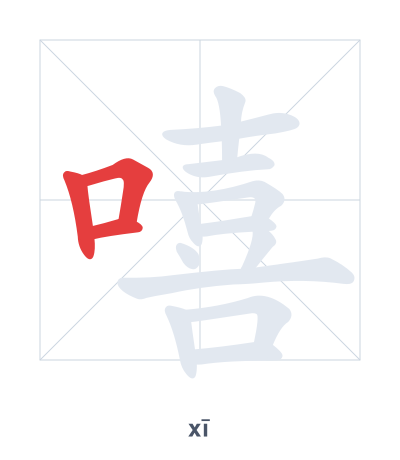
Open Hanzi Writer to see the animated stroke order and practice writing 嘻 with real-time feedback.
The character 嘻 (xī) is written with 15 strokes. Follow the standard Chinese stroke order: top to bottom, left to right, outside before inside. The radical 口 is one of its key components.
Practice the correct stroke order with the Hanzi Writer app to see animated stroke-by-stroke guidance with real-time feedback.
嘻 means hehe; giggling sound.
嘻 combines the mouth radical (口) with 喜 (xǐ, 'joy'), indicating a happy sound made by the mouth. It's a phono-semantic compound where 口 provides the meaning of sound, and 喜 supplies pronunciation while hinting at the joyful emotion behind the giggle.
💡 Memory Tip: Imagine a mouth (口) shaped like a grin, endlessly giggling 'hee hee' because it sees the joyful face of 喜 (two drumsticks over a drum) – that's the sound of 嘻.
她嘻嘻地笑了。
tā xī xī dì xiào le
She giggled.
我喜欢嘻哈音乐。
wǒ xǐ huān xī hā yīn yuè
I like hip-hop music.
他整天笑嘻嘻的。
tā zhěng tiān xiào xī xī de
He is grinning and smiling all day long.
Open Hanzi Writer to see the animated stroke order and practice writing 嘻 with real-time feedback.
✨ Animated stroke order · Handwriting recognition · HSK-graded practice · Free to use
嘻 has two parts: on the left is the radical 口 (mouth), and on the right is 喜 (happy/joy). The mouth radical suggests sound, while 喜 adds the idea of happiness, so together they represent a happy giggling sound like 'hehe'.