卧 (wò) means "to lie down / bedroom" in Chinese. It has 8 strokes with the radical 臣, and is HSK Level 5.
Rated 3.7/5 in difficulty (challenging).
Harder than 31% of HSK Level 5 characters.
Appears in 3+ common words including 卧室 (wò shì), 卧铺 (wò pù), 仰卧起坐 (yǎng wò qǐ zuò).
Due to its 8 strokes, Hanzi Writer's error detection shows 卧 requires focused practice — most learners need 10+ attempts for consistent accuracy.
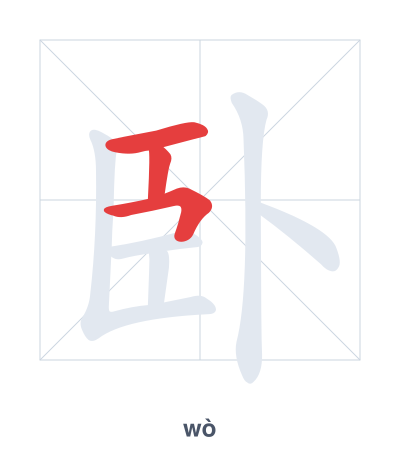
Open Hanzi Writer to see the animated stroke order and practice writing 卧 with real-time feedback.
The character 卧 (wò) is written with 8 strokes. Follow the standard Chinese stroke order: top to bottom, left to right, outside before inside. The radical 臣 is one of its key components.
Practice the correct stroke order with the Hanzi Writer app to see animated stroke-by-stroke guidance with real-time feedback.
卧 means to lie down / bedroom.
As an HSK Level 5 character, 卧 is an intermediate-level character.
卧 is a compound of 臣 (a kneeling person) and a variation of 人 (person) that depicts a reclining posture, together conveying the idea of lying down. The left component 臣 originally showed a bowed figure, while the right side evolved from a bent human form, visually representing someone at rest.
💡 Memory Tip: Imagine a minister (臣) lying down and using a divination stick (卜) as a pillow.
我的卧室里有一张床。
wǒ de wò shì lǐ yǒu yī zhāng chuáng
There is a bed in my bedroom.
我买了火车的硬卧铺。
wǒ mǎi le huǒ chē de yìng wò pù
I bought a hard sleeper ticket for the train.
我每天做五十个仰卧起坐。
wǒ měi tiān zuò wǔ shí gè yǎng wò qǐ zuò
I do fifty sit-ups every day.
Open Hanzi Writer to see the animated stroke order and practice writing 卧 with real-time feedback.
✨ Animated stroke order · Handwriting recognition · HSK-graded practice · Free to use
卧 is made of the radical 臣 (minister) on the left and 卜 (divination) on the right. The left part 臣 originally showed a kneeling person, which connects to the idea of a person lying down. The right part 卜 adds a phonetic hint, though the exact link is not certain.