倭 (wō) means "dwarf; (archaic) Japan" in Chinese. It has 10 strokes with the radical 亻.
Rated 3.9/5 in difficulty (challenging).
Appears in 3+ common words including 倭瓜 (wō guā), 倭寇 (wō kòu), 倭人 (wō rén).
Due to its 10 strokes, Hanzi Writer's error detection shows 倭 requires focused practice — most learners need 10+ attempts for consistent accuracy.
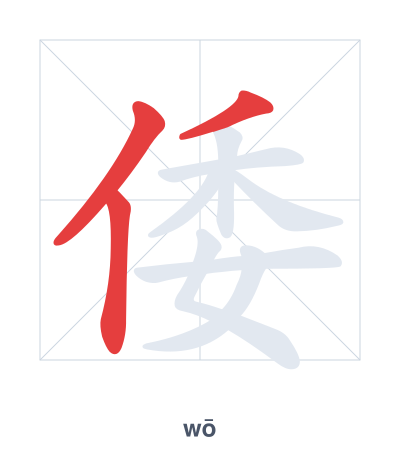
Open Hanzi Writer to see the animated stroke order and practice writing 倭 with real-time feedback.
The character 倭 (wō) is written with 10 strokes. Follow the standard Chinese stroke order: top to bottom, left to right, outside before inside. The radical 亻 is one of its key components.
Practice the correct stroke order with the Hanzi Writer app to see animated stroke-by-stroke guidance with real-time feedback.
倭 means dwarf; (archaic) Japan.
倭 combines the person radical 亻 with 委 (wěi, meaning 'to bend' or 'submit'). A person who is bent or crouched suggests a small stature, hence the original meaning of 'dwarf'. Historically, it was used to refer to Japan, possibly based on the ancient Chinese perception of the Japanese as a small or submissive people.
💡 Memory Tip: Imagine a tiny person (亻) so small they have to bend and submit (委) to reach a doorknob—that's a dwarf, or the old name for Japan.
这种倭瓜很好吃。
zhè zhǒng wō guā hěn hǎo chī
This kind of squash is delicious.
历史书里提到了倭寇。
lì shǐ shū lǐ tí dào le wō kòu
Japanese pirates are mentioned in history books.
古代称呼他们为倭人。
gǔ dài chēng hū tā men wèi wō rén
In ancient times, they were called Woren.
Open Hanzi Writer to see the animated stroke order and practice writing 倭 with real-time feedback.
✨ Animated stroke order · Handwriting recognition · HSK-graded practice · Free to use
倭 consists of the person radical 亻 on the left and the phonetic component 委 on the right. 委 itself is made of 禾 (grain) and 女 (woman), but together they suggest the idea of bowing or bending. This connects to the meaning "dwarf" (a small person who might bow), while the historical use for Japan came from an ancient Chinese name for the islands.