寇 (kòu) means "bandit; invader" in Chinese. It has 11 strokes with the radical 宀.
Rated 4.2/5 in difficulty (advanced).
Appears in 3+ common words including 倭寇 (wō kòu), 敌寇 (dí kòu), 贼寇 (zéi kòu).
Due to its 11 strokes, Hanzi Writer's error detection shows 寇 requires focused practice — most learners need 10+ attempts for consistent accuracy.
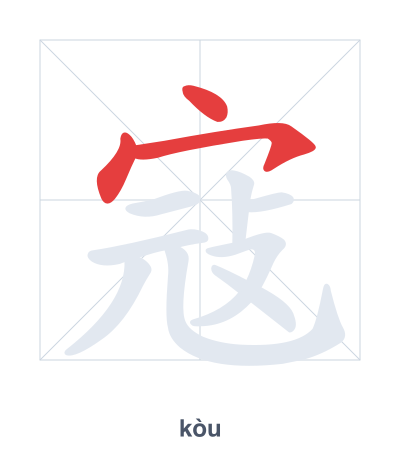
Open Hanzi Writer to see the animated stroke order and practice writing 寇 with real-time feedback.
The character 寇 (kòu) is written with 11 strokes. Follow the standard Chinese stroke order: top to bottom, left to right, outside before inside. The radical 宀 is one of its key components.
Practice the correct stroke order with the Hanzi Writer app to see animated stroke-by-stroke guidance with real-time feedback.
寇 means bandit; invader.
寇 combines a roof (宀), a head (元), and a hand striking (攴) — picturing an invader breaking into a house and attacking someone's head. The ancient form similarly shows a person under a roof being assaulted, symbolizing a bandit or enemy invader.
💡 Memory Tip: Picture a bandit sneaking under your roof (宀), clubbing a person's head (元) with a weapon (攴) to steal your stuff.
历史书里提到了倭寇。
lì shǐ shū lǐ tí dào le wō kòu
Japanese pirates are mentioned in history books.
我们要保卫国家抗击敌寇。
wǒ men yào bǎo wèi guó jiā kàng jī dí kòu
We must defend the country and fight against enemies.
官兵正在追捕贼寇。
guān bīng zhèng zài zhuī bǔ zéi kòu
The government soldiers are chasing the bandits.
Open Hanzi Writer to see the animated stroke order and practice writing 寇 with real-time feedback.
✨ Animated stroke order · Handwriting recognition · HSK-graded practice · Free to use
寇 (kòu) has the radical 宀 (roof) at the top, representing a house or shelter, and the lower part combines 元 (yuan) and 攴 (pū, a hand striking). Together, the structure suggests someone breaking into a house and attacking, which relates to bandits and invaders.