Hanzi Writer

How to Write 吻 (wěn) — Meaning “to kiss”

wěn HSK Level 7 7 strokes Radical: 口

吻 (wěn) means "to kiss" in Chinese. It has 7 strokes with the radical 口, and is HSK Level 7.

Rated 3.5/5 in difficulty (challenging).

Harder than 15% of HSK Level 7 characters.

Appears in 3+ common words including 亲吻 (qīn wěn), 接吻 (jiē wěn), 吻别 (wěn bié).

Due to its 7 strokes, Hanzi Writer's error detection shows 吻 requires focused practice — most learners need 10+ attempts for consistent accuracy.
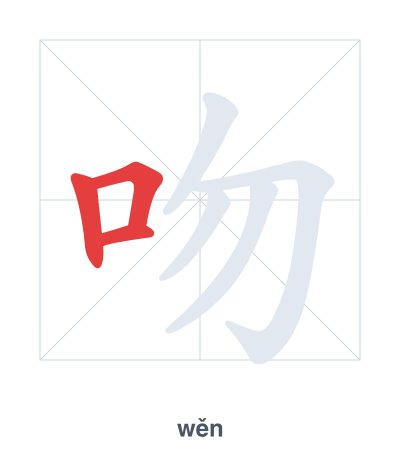
Stroke order practice for 吻 - wěn

Practice Writing 吻 (wěn)

Open Hanzi Writer to see the animated stroke order and practice writing 吻 with real-time feedback.

The character (wěn) is written with 7 strokes. Follow the standard Chinese stroke order: top to bottom, left to right, outside before inside. The radical is one of its key components.

Practice the correct stroke order with the Hanzi Writer app to see animated stroke-by-stroke guidance with real-time feedback.

means to kiss.

As an HSK Level 7 character, is an intermediate-level character.

Character
Pinyinwěn (wen)
Meaningto kiss
Strokes7
Radical
HSK Level7
Difficulty3.5/5

吻 is a compound character with a semantic component 口 (mouth) and a phonetic component 勿 (wù, meaning 'do not'). The mouth radical directly connects the character to the action of kissing, which is performed with the lips. Historically, 勿 serves as a sound hint while the overall meaning evolved from 'mouth' to 'to kiss'.

💡 Memory Tip: Picture a mouth (口) that says 'don't (勿) make a sound' just before stealing a kiss.

qīn wěn
to kiss
jiē wěn
to kiss
wěn bié
to kiss goodbye

妈妈亲吻了孩子。

mā mā qīn wěn le hái zi

Mom kissed the child.

他们在电影里接吻。

tā men zài diàn yǐng lǐ jiē wěn

They are kissing in the movie.

他们在车站吻别。

tā men zài chē zhàn wěn bié

They kissed goodbye at the station.

Character Pinyin Strokes Radical
(current) wěn 7
5
5
gōu / jù 5
Stroke order practice for 吻 - wěn

Practice Writing 吻 (wěn)

Open Hanzi Writer to see the animated stroke order and practice writing 吻 with real-time feedback.

✨ Animated stroke order · Handwriting recognition · HSK-graded practice · Free to use

Frequently Asked Questions about 吻

吻 is composed of the radical 口 (mouth) on the left and 勿 (not, do not) on the right. The mouth radical directly connects to the action of kissing, while 勿 originally served as a phonetic component indicating the pronunciation wěn. Together, they form a character meaning "to kiss."

More HSK Level 7 Characters

Characters with Radical 口

Other 7-Stroke Characters