Hanzi Writer

How to Write 惋 (wǎn) — Meaning “To regret”

wǎn HSK Level 7 11 strokes Radical: 忄

惋 (wǎn) means "To regret" in Chinese. It has 11 strokes with the radical 忄, and is HSK Level 7.

Rated 4.2/5 in difficulty (advanced).

Harder than 55% of HSK Level 7 characters.

Appears in 3+ common words including 惋惜 (wǎn xī), 叹惋 (tàn wǎn), 哀惋 (āi wǎn).

Due to its 11 strokes, Hanzi Writer's error detection shows 惋 requires focused practice — most learners need 10+ attempts for consistent accuracy.
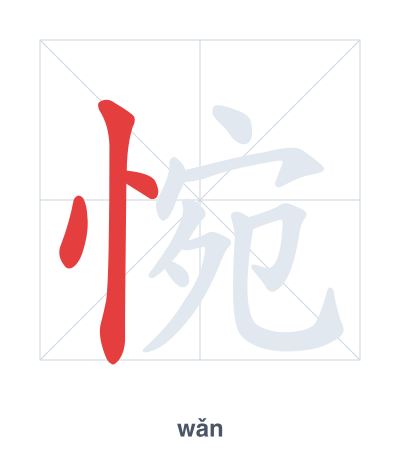
Stroke order practice for 惋 - wǎn

Practice Writing 惋 (wǎn)

Open Hanzi Writer to see the animated stroke order and practice writing 惋 with real-time feedback.

The character (wǎn) is written with 11 strokes. Follow the standard Chinese stroke order: top to bottom, left to right, outside before inside. The radical is one of its key components.

Practice the correct stroke order with the Hanzi Writer app to see animated stroke-by-stroke guidance with real-time feedback.

means To regret.

As an HSK Level 7 character, is an intermediate-level character.

Character
Pinyinwǎn (wan)
MeaningTo regret
Strokes11
Radical
HSK Level7
Difficulty4.2/5

The left component 忄 (a heart) indicates this character relates to emotions. The right side 宛 (wǎn) means 'to bend' or 'curved,' suggesting the heart is twisted or bent in sorrow, vividly portraying a sense of regret.

💡 Memory Tip: Imagine your heart (忄) bending like a curved road (宛 ­— think of a winding path) as you look back and regret a wrong turn.

wǎn xī
To feel sorry for
tàn wǎn
to sigh with regret
āi wǎn
mournful

大家都为他感到惋惜。

dà jiā dōu wèi tā gǎn dào wǎn xī

Everyone felt sorry for him.

他发出了一声叹惋。

tā fā chū le yī shēng tàn wǎn

He let out a sigh of regret.

音乐听起来很哀惋。

yīn yuè tīng qǐ lái hěn āi wǎn

The music sounds very mournful.

Character Pinyin Strokes Radical
(current) wǎn 11
xún 9
shì 9
huǎng 9
Stroke order practice for 惋 - wǎn

Practice Writing 惋 (wǎn)

Open Hanzi Writer to see the animated stroke order and practice writing 惋 with real-time feedback.

✨ Animated stroke order · Handwriting recognition · HSK-graded practice · Free to use

Frequently Asked Questions about 惋

The left side is 忄 (heart radical), which indicates emotions or feelings. The right side is 宛 (wǎn), which originally meant 'bent' or 'crooked,' suggesting a twisted or painful feeling in the heart. Together, 惋 conveys the emotion of regret or sorrow.

More HSK Level 7 Characters

Characters with Radical 忄

Other 11-Stroke Characters