惕 (tì) means "Vigilant" in Chinese. It has 11 strokes with the radical 忄, and is HSK Level 7.
Rated 4.2/5 in difficulty (advanced).
Harder than 55% of HSK Level 7 characters.
Appears in 3+ common words including 警惕 (jǐng tì), 惕厉 (tì lì), 戒惕 (jiè tì).
Due to its 11 strokes, Hanzi Writer's error detection shows 惕 requires focused practice — most learners need 10+ attempts for consistent accuracy.
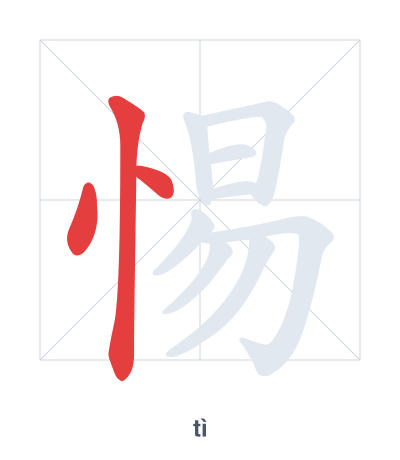
Open Hanzi Writer to see the animated stroke order and practice writing 惕 with real-time feedback.
The character 惕 (tì) is written with 11 strokes. Follow the standard Chinese stroke order: top to bottom, left to right, outside before inside. The radical 忄 is one of its key components.
Practice the correct stroke order with the Hanzi Writer app to see animated stroke-by-stroke guidance with real-time feedback.
惕 means Vigilant.
As an HSK Level 7 character, 惕 is an intermediate-level character.
惕 is a phono-semantic compound. The heart radical (忄) indicates it relates to mental state, while 易 (change) provides the sound and suggests alertness to changes. Together, they depict a mind that stays watchful and ready for shifting circumstances.
💡 Memory Tip: Picture a vigilant heart (忄) staring at a sneaky chameleon (易) that keeps changing colors, always on guard.
我们要保持警惕。
wǒ men yào bǎo chí jǐng tì
We must remain vigilant.
他时刻惕厉自己。
tā shí kè tì lì zì jǐ
He constantly urges himself to be vigilant.
这种行为值得戒惕。
zhè zhǒng xíng wéi zhí de jiè tì
This behavior warrants vigilance.
Open Hanzi Writer to see the animated stroke order and practice writing 惕 with real-time feedback.
✨ Animated stroke order · Handwriting recognition · HSK-graded practice · Free to use
惕 is composed of the radical 忄 (heart/mind) on the left and 易 (change) on the right. The heart radical suggests a mental state, and 易 hints at being alert to changes, which together convey the idea of vigilance. This structure reflects that being vigilant requires a mind focused on possible shifts in your surroundings.