涛 (tāo) means "great waves; billows" in Chinese. It has 10 strokes with the radical 氵, and is HSK Level 7.
Rated 4.2/5 in difficulty (advanced).
Harder than 66% of HSK Level 7 characters.
Appears in 3+ common words including 波涛 (bō tāo), 浪涛 (làng tāo), 涛声 (tāo shēng).
Due to its 10 strokes, Hanzi Writer's error detection shows 涛 requires focused practice — most learners need 10+ attempts for consistent accuracy.
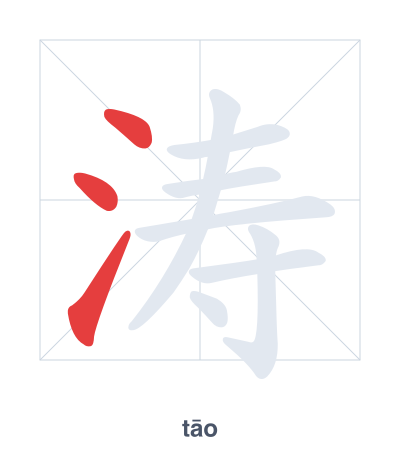
Open Hanzi Writer to see the animated stroke order and practice writing 涛 with real-time feedback.
The character 涛 (tāo) is written with 10 strokes. Follow the standard Chinese stroke order: top to bottom, left to right, outside before inside. The radical 氵 is one of its key components.
Practice the correct stroke order with the Hanzi Writer app to see animated stroke-by-stroke guidance with real-time feedback.
涛 means great waves; billows.
As an HSK Level 7 character, 涛 is an intermediate-level character.
涛 is a phono-semantic compound combining the water radical (氵) with 寿 (shòu, 'longevity') as a phonetic component. The character evokes the image of a great wave that rolls on endlessly, like a long life of water's powerful motion.
💡 Memory Tip: Picture a huge wave (氵) that seems to last a lifetime (寿), rising and crashing with endless billows.
大海里有巨大的波涛。
dà hǎi lǐ yǒu jù dà de bō tāo
There are huge waves in the sea.
浪涛拍打着岸边。
làng tāo pāi dǎ zhe àn biān
The waves are crashing against the shore.
我喜欢听涛声。
wǒ xǐ huān tīng tāo shēng
I like listening to the sound of waves.
Open Hanzi Writer to see the animated stroke order and practice writing 涛 with real-time feedback.
✨ Animated stroke order · Handwriting recognition · HSK-graded practice · Free to use
涛 is made of two parts: the left side is the radical 氵 (three dots), which represents water, and the right side is 寿 (shòu), meaning longevity or a long time. Together, they suggest water moving over a long period, forming great waves or billows.