浪 (làng) means "wave / billow" in Chinese. It has 10 strokes with the radical 氵, and is HSK Level 3.
Rated 4.2/5 in difficulty (advanced).
Harder than 82% of HSK Level 3 characters.
Appears in 3+ common words including 浪漫 (làng màn), 浪费 (làng fèi), 海浪 (hǎi làng).
Due to its 10 strokes, Hanzi Writer's error detection shows 浪 requires focused practice — most learners need 10+ attempts for consistent accuracy.
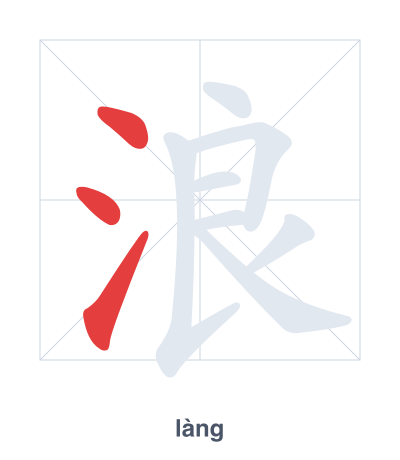
Open Hanzi Writer to see the animated stroke order and practice writing 浪 with real-time feedback.
The character 浪 (làng) is written with 10 strokes. Follow the standard Chinese stroke order: top to bottom, left to right, outside before inside. The radical 氵 is one of its key components.
Practice the correct stroke order with the Hanzi Writer app to see animated stroke-by-stroke guidance with real-time feedback.
浪 means wave / billow.
As an HSK Level 3 character, 浪 is an intermediate-level character.
浪 is a phono-semantic compound: the radical 氵 (water) indicates it relates to water, while 良 (liáng, 'good') provides the approximate sound 'lang' and also suggests the idea of something continuous or flowing, as in a 'good' or steady wave.
💡 Memory Tip: Imagine a wave (氵) that is so 'good' (良) and perfect for surfing that you shout "Lang!" as you ride it.
这个故事很浪漫。
zhè ge gù shì hěn làng màn
This story is very romantic.
不要浪费时间。
bú yào làng fèi shí jiān
Don't waste time.
海浪拍打着沙滩。
hǎi làng pāi dǎ zhe shā tān
The waves are lapping against the beach.
Open Hanzi Writer to see the animated stroke order and practice writing 浪 with real-time feedback.
✨ Animated stroke order · Handwriting recognition · HSK-graded practice · Free to use
浪 is made up of the water radical 氵 on the left and the phonetic component 良 (liáng) on the right. The water radical hints that the character relates to water, and 良 provides a clue to the pronunciation. Together they form a character meaning 'wave' or 'billow', which are movements of water.