倘 (tǎng) means "If; supposing." in Chinese. It has 10 strokes with the radical 亻, and is HSK Level 7.
Rated 3.9/5 in difficulty (challenging).
Harder than 33% of HSK Level 7 characters.
Appears in 3+ common words including 倘若 (tǎng ruò), 倘使 (tǎng shǐ), 倘或 (tǎng huò).
Due to its 10 strokes, Hanzi Writer's error detection shows 倘 requires focused practice — most learners need 10+ attempts for consistent accuracy.
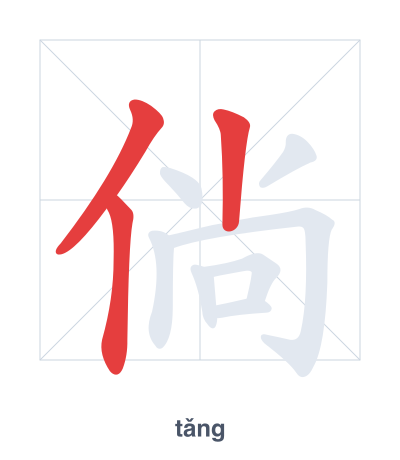
Open Hanzi Writer to see the animated stroke order and practice writing 倘 with real-time feedback.
The character 倘 (tǎng) is written with 10 strokes. Follow the standard Chinese stroke order: top to bottom, left to right, outside before inside. The radical 亻 is one of its key components.
Practice the correct stroke order with the Hanzi Writer app to see animated stroke-by-stroke guidance with real-time feedback.
倘 means If; supposing..
As an HSK Level 7 character, 倘 is an intermediate-level character.
The character 倘 is a phono-semantic compound. The left radical 亻 (person) hints at human agency, and the right component 尚 (shàng, meaning 'still' or 'yet') supplies the sound and suggests a state of hesitation—together they evoke the idea of weighing a hypothetical condition.
💡 Memory Tip: Picture a person (亻) standing still (尚) on a tightrope, thinking 'if' they should take the next step.
倘若下雨就不去了。
tǎng ruò xià yǔ jiù bù qù le
If it rains, we won't go.
倘使有空请来玩。
tǎng shǐ yǒu kòng qǐng lái wán
If you are free, please come and visit.
倘或不行再商量。
tǎng huò bù xíng zài shāng liáng
If it doesn't work, we can discuss it again.
Open Hanzi Writer to see the animated stroke order and practice writing 倘 with real-time feedback.
✨ Animated stroke order · Handwriting recognition · HSK-graded practice · Free to use
The character 倘 consists of the person radical 亻 on the left and 尚 on the right. The radical indicates the word relates to a person's situation, while 尚 originally provided the pronunciation. Together they form a function word meaning "if" or "supposing," used to introduce a hypothetical condition.