Hanzi Writer

How to Write 镗 (tāng) — Meaning “to bore (a hole)”

tāng 16 strokes Radical: 钅

镗 (tāng) means "to bore (a hole)" in Chinese. It has 16 strokes with the radical 钅.

Rated 4.2/5 in difficulty (advanced).

Appears in 3+ common words including 镗床 (tāng chuáng), 镗孔 (tāng kǒng), 镗镗 (tāng tāng).

Due to its 16 strokes, Hanzi Writer's error detection shows 镗 requires focused practice — most learners need 10+ attempts for consistent accuracy.
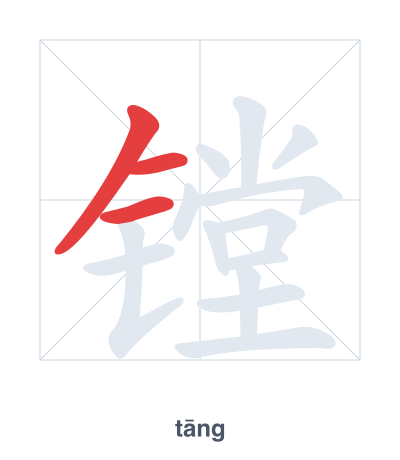
Stroke order practice for 镗 - tāng

Practice Writing 镗 (tāng)

Open Hanzi Writer to see the animated stroke order and practice writing 镗 with real-time feedback.

The character (tāng) is written with 16 strokes. Follow the standard Chinese stroke order: top to bottom, left to right, outside before inside. The radical is one of its key components.

Practice the correct stroke order with the Hanzi Writer app to see animated stroke-by-stroke guidance with real-time feedback.

means to bore (a hole).

Character
Pinyintāng (tang)
Meaningto bore (a hole)
Strokes16
Radical
Difficulty4.2/5

The character 镗 is a phono-semantic compound, with the radical 钅 (metal) indicating a metal tool used for boring, and the component 堂 (táng) providing the pronunciation. This structure reflects a metal drill or reamer used to bore holes, linking the visual form to the meaning.

💡 Memory Tip: Imagine a metal drill (钅) boring a hole straight through the floor of a grand hall (堂).

tāng chuáng
boring machine
tāng kǒng
boring a hole
tāng tāng
clanging sound

工厂里有一台大镗床。

gōng chǎng lǐ yǒu yī tái dà tāng chuáng

There is a large boring machine in the factory.

师傅正在给零件镗孔。

shī fù zhèng zài gěi líng jiàn tāng kǒng

The master worker is boring a hole in the part.

锣声镗镗地响了起来。

luó shēng tāng tāng dì xiǎng le qǐ lái

The gong began to sound with a loud clang.

Character Pinyin Strokes Radical
(current) tāng 16
qiè 14
kǎi 14
qiāng 14
Stroke order practice for 镗 - tāng

Practice Writing 镗 (tāng)

Open Hanzi Writer to see the animated stroke order and practice writing 镗 with real-time feedback.

✨ Animated stroke order · Handwriting recognition · HSK-graded practice · Free to use

Frequently Asked Questions about 镗

镗 is composed of the radical 钅 (jīn, meaning 'metal' or 'gold') on the left, and the phonetic component 堂 (táng, meaning 'hall') on the right. The metal radical hints that the character relates to metalworking, and together with 堂 it indicates the action of boring a hole in metal parts.

Characters with Radical 钅

Other 16-Stroke Characters