滩 (tān) means "beach; shoal; sands" in Chinese. It has 13 strokes with the radical 氵, and is HSK Level 7.
Rated 4.2/5 in difficulty (advanced).
Harder than 69% of HSK Level 7 characters.
Appears in 3+ common words including 沙滩 (shā tān), 海滩 (hǎi tān), 河滩 (hé tān).
Due to its 13 strokes, Hanzi Writer's error detection shows 滩 requires focused practice — most learners need 10+ attempts for consistent accuracy.
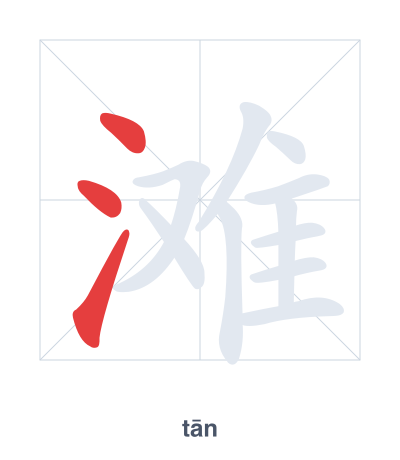
Open Hanzi Writer to see the animated stroke order and practice writing 滩 with real-time feedback.
The character 滩 (tān) is written with 13 strokes. Follow the standard Chinese stroke order: top to bottom, left to right, outside before inside. The radical 氵 is one of its key components.
Practice the correct stroke order with the Hanzi Writer app to see animated stroke-by-stroke guidance with real-time feedback.
滩 means beach; shoal; sands.
As an HSK Level 7 character, 滩 is an intermediate-level character.
The character 滩 combines the water radical 氵 with 难 (difficult), as sandy shoals or beaches are areas where water flows over uneven ground, making navigation treacherous. The left side represents water, while the right side hints at the challenging nature of these shallow, obstructive landscapes.
💡 Memory Tip: At the beach (氵), it's so difficult (难) to run because your feet sink into the soft sand.
孩子们在沙滩玩。
hái zi men zài shā tān wán
The children are playing on the beach.
海滩上有很多贝壳。
hǎi tān shàng yǒu hěn duō bèi ké
There are many shells on the beach.
牛在河滩上吃草。
niú zài hé tān shàng chī cǎo
The cattle are grazing on the riverbank.
Open Hanzi Writer to see the animated stroke order and practice writing 滩 with real-time feedback.
✨ Animated stroke order · Handwriting recognition · HSK-graded practice · Free to use
滩 consists of the water radical 氵 on the left and the character 难 (nán, meaning difficult) on the right. The water radical hints that 滩 refers to a location near water like a beach or riverbank, while 难 provides the sound and may suggest the uneven, challenging surface of a shoal.