颂 (sòng) means "To praise / Ode" in Chinese. It has 10 strokes with the radical 页, and is HSK Level 7.
Rated 4.2/5 in difficulty (advanced).
Harder than 97% of HSK Level 7 characters.
Appears in 3+ common words including 歌颂 (gē sòng), 颂扬 (sòng yáng), 颂词 (sòng cí).
Due to its 10 strokes, Hanzi Writer's error detection shows 颂 requires focused practice — most learners need 10+ attempts for consistent accuracy.
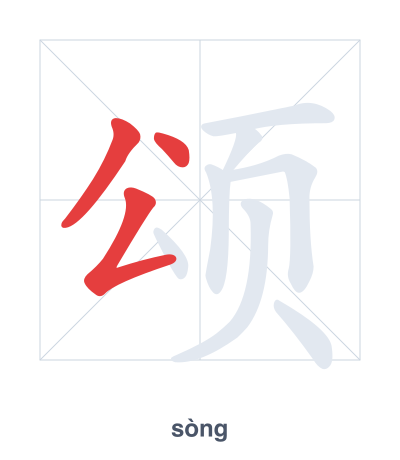
Open Hanzi Writer to see the animated stroke order and practice writing 颂 with real-time feedback.
The character 颂 (sòng) is written with 10 strokes. Follow the standard Chinese stroke order: top to bottom, left to right, outside before inside. The radical 页 is one of its key components.
Practice the correct stroke order with the Hanzi Writer app to see animated stroke-by-stroke guidance with real-time feedback.
颂 means To praise / Ode.
As an HSK Level 7 character, 颂 is an intermediate-level character.
颂 combines 公 (gōng, 'public' or phonetic) and 页 (yè, 'head/page'), originally referring to a ceremonial ode written on a page or head. The character's visual form connects to 'praise' through the idea of a public declaration or hymn honoring someone.
💡 Memory Tip: Imagine a proud head (页) being publicly praised (公) in a grand ode.
大家歌颂美好的生活。
dà jiā gē sòng měi hǎo de shēng huó
Everyone sings praises of a beautiful life.
他的精神值得颂扬。
tā de jīng shén zhí de sòng yáng
His spirit is worthy of praise.
他写了一篇颂词。
tā xiě le yī piān sòng cí
He wrote a eulogy.
Open Hanzi Writer to see the animated stroke order and practice writing 颂 with real-time feedback.
✨ Animated stroke order · Handwriting recognition · HSK-graded practice · Free to use
颂 is composed of 公 (gōng, public) on the left and 页 (yè, page or head) on the right. The right side 页 suggests something related to the head or face, while the left side 公 hints at public recognition, together meaning to publicly praise or honor.