嘶 (sī) means "to hiss; to neigh; to roar" in Chinese. It has 15 strokes with the radical 口.
Rated 4.2/5 in difficulty (advanced).
Appears in 3+ common words including 嘶吼 (sī hǒu), 嘶嘶 (sī sī), 嘶哑 (sī yǎ).
Due to its 15 strokes, Hanzi Writer's error detection shows 嘶 requires focused practice — most learners need 10+ attempts for consistent accuracy.
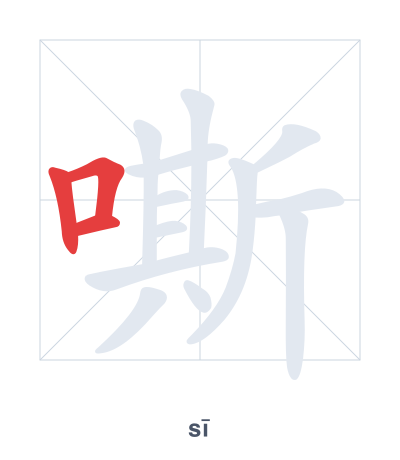
Open Hanzi Writer to see the animated stroke order and practice writing 嘶 with real-time feedback.
The character 嘶 (sī) is written with 15 strokes. Follow the standard Chinese stroke order: top to bottom, left to right, outside before inside. The radical 口 is one of its key components.
Practice the correct stroke order with the Hanzi Writer app to see animated stroke-by-stroke guidance with real-time feedback.
嘶 means to hiss; to neigh; to roar.
嘶 is a compound character with the mouth radical (口) indicating a sound made by the mouth, and the phonetic component 斯 (sī) providing pronunciation and suggesting the idea of 'splitting' or 'tearing' the air. Together, they convey the sharp, forceful sounds of hissing, neighing, or roaring.
💡 Memory Tip: A horse opens its mouth (口) wide and lets out a fierce neigh that splits the air like an axe (斤) cutting through its stable (其).
狮子在嘶吼。
shī zi zài sī hǒu
The lion is roaring.
蛇发出嘶嘶声。
shé fā chū sī sī shēng
The snake makes a hissing sound.
他的声音很嘶哑。
tā de shēng yīn hěn sī yǎ
His voice is very hoarse.
Open Hanzi Writer to see the animated stroke order and practice writing 嘶 with real-time feedback.
✨ Animated stroke order · Handwriting recognition · HSK-graded practice · Free to use
嘶 combines the radical 口 (mouth) on the left, indicating sounds from the mouth, with 斯 (sī) on the right, which contributes the pronunciation. The radical shows that this character is about vocal sounds, like hissing, neighing, or roaring.