吼 (hǒu) means "to roar" in Chinese. It has 7 strokes with the radical 口, and is HSK Level 7.
Rated 3.5/5 in difficulty (challenging).
Harder than 15% of HSK Level 7 characters.
Appears in 3+ common words including 吼叫 (hǒu jiào), 大吼 (dà hǒu), 吼一声 (hǒu yī shēng).
Due to its 7 strokes, Hanzi Writer's error detection shows 吼 requires focused practice — most learners need 10+ attempts for consistent accuracy.
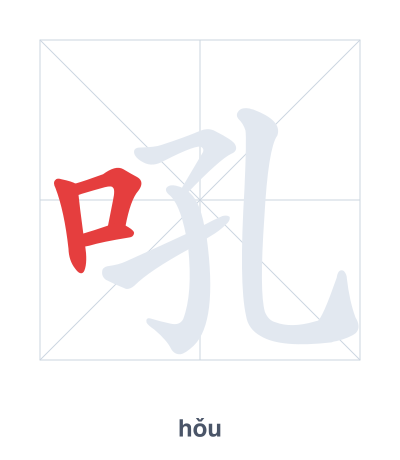
Open Hanzi Writer to see the animated stroke order and practice writing 吼 with real-time feedback.
The character 吼 (hǒu) is written with 7 strokes. Follow the standard Chinese stroke order: top to bottom, left to right, outside before inside. The radical 口 is one of its key components.
Practice the correct stroke order with the Hanzi Writer app to see animated stroke-by-stroke guidance with real-time feedback.
吼 means to roar.
As an HSK Level 7 character, 吼 is an intermediate-level character.
吼 is a compound character with the radical 口 (mouth) and the component 孔 (hole/cavity). The mouth indicates a sound produced, while 孔 suggests the deep, resonant cavity of a throat roaring. Its structure conveys a powerful vocal emission from a wide-open mouth.
💡 Memory Tip: Picture a lion opening its giant mouth (口) revealing a deep dark hole (孔) as it lets out a thunderous roar.
狮子在远处吼叫。
shī zi zài yuǎn chù hǒu jiào
The lion is roaring in the distance.
请别对我大吼。
qǐng bié duì wǒ dà hǒu
Please don't shout at me.
他大吼一声跑了。
tā dà hǒu yī shēng pǎo le
He gave a loud shout and ran away.
Open Hanzi Writer to see the animated stroke order and practice writing 吼 with real-time feedback.
✨ Animated stroke order · Handwriting recognition · HSK-graded practice · Free to use
The left side 口 means "mouth," and the right side 孔 represents a "hole" or "cavity." Together, they suggest a loud sound coming from deep in the throat, which matches the meaning "to roar."