芦 (lú) means "Reed" in Chinese. It has 7 strokes with the radical 艹, and is HSK Level 7.
Rated 3.5/5 in difficulty (challenging).
Harder than 21% of HSK Level 7 characters.
Appears in 3+ common words including 芦荟 (lú huì), 葫芦 (hú lú), 芦苇 (lú wěi).
Due to its 7 strokes, Hanzi Writer's error detection shows 芦 requires focused practice — most learners need 10+ attempts for consistent accuracy.
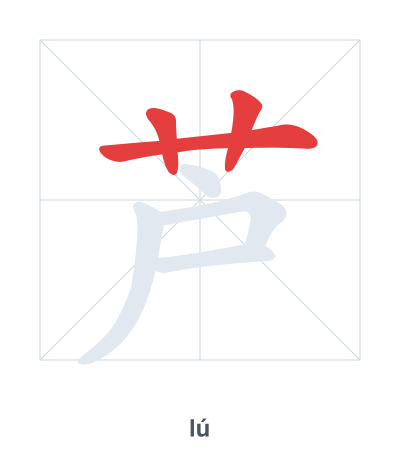
Open Hanzi Writer to see the animated stroke order and practice writing 芦 with real-time feedback.
The character 芦 (lú) is written with 7 strokes. Follow the standard Chinese stroke order: top to bottom, left to right, outside before inside. The radical 艹 is one of its key components.
Practice the correct stroke order with the Hanzi Writer app to see animated stroke-by-stroke guidance with real-time feedback.
芦 means Reed.
As an HSK Level 7 character, 芦 is an intermediate-level character.
芦 is a phono-semantic compound: the radical 艹 (grass) indicates this is a plant, and the component 卢 (lú) provides the pronunciation. The character refers to reeds, tall grass-like plants that commonly grow near water.
💡 Memory Tip: Imagine a patch of grass (艹) sprouting from a black dog's head (卢) as it hides in a marsh full of reeds.
芦荟对皮肤很好。
lú huì duì pí fū hěn hǎo
Aloe vera is very good for the skin.
这个葫芦很可爱。
zhè ge hú lú hěn kě ài
This bottle gourd is very cute.
河边长满了芦苇。
hé biān zhǎng mǎn le lú wěi
The riverside is covered with reeds.
Open Hanzi Writer to see the animated stroke order and practice writing 芦 with real-time feedback.
✨ Animated stroke order · Handwriting recognition · HSK-graded practice · Free to use
芦 is composed of the radical 艹 (grass) on top and 户 (door/household) below. The grass radical shows that 芦 refers to a type of plant, while 户 hints at the reed's common use in making doors or mats in ancient times.