捎 (shāo) means "to bring or pass on" in Chinese. It has 10 strokes with the radical 扌, and is HSK Level 7.
Rated 4.2/5 in difficulty (advanced).
Harder than 58% of HSK Level 7 characters.
Appears in 3+ common words including 捎话 (shāo huà), 捎带 (shāo dài), 捎信 (shāo xìn).
Due to its 10 strokes, Hanzi Writer's error detection shows 捎 requires focused practice — most learners need 10+ attempts for consistent accuracy.
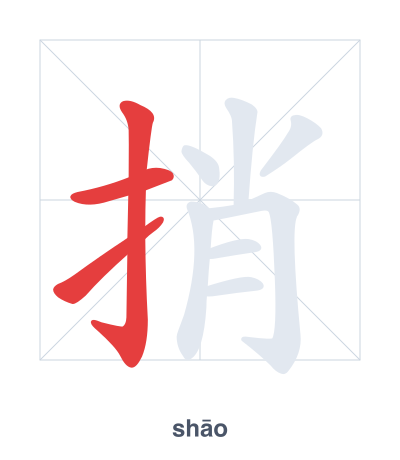
Open Hanzi Writer to see the animated stroke order and practice writing 捎 with real-time feedback.
The character 捎 (shāo) is written with 10 strokes. Follow the standard Chinese stroke order: top to bottom, left to right, outside before inside. The radical 扌 is one of its key components.
Practice the correct stroke order with the Hanzi Writer app to see animated stroke-by-stroke guidance with real-time feedback.
捎 means to bring or pass on.
As an HSK Level 7 character, 捎 is an intermediate-level character.
捎 is a compound character with the hand radical 扌, indicating an action done with the hand, and the phonetic component 肖 (xiào), which originally meant 'small' or 'resemble.' The character conveys the idea of using your hand to carry or pass along a small item to someone else, like bringing a message or parcel.
💡 Memory Tip: Imagine your hand (扌) passing a tiny moon (肖—think of 'little' shape) to a friend, meaning you 'bring or pass on' something small.
如果您见到张老师,请帮我捎话给他。
rú guǒ nín jiàn dào zhāng lǎo shī , qǐng bāng wǒ shāo huà gěi tā 。
If you see Teacher Zhang, please pass a message to him for me.
我捎带买了一瓶水。
wǒ shāo dài mǎi le yī píng shuǐ
I bought a bottle of water while I was at it.
王叔叔托我给在城里打工的儿子捎信。
wáng shū shū tuō wǒ gěi zài chéng lǐ dǎ gōng de ér zi shāo xìn 。
Uncle Wang asked me to deliver a message to his son who is working in the city.
Open Hanzi Writer to see the animated stroke order and practice writing 捎 with real-time feedback.
✨ Animated stroke order · Handwriting recognition · HSK-graded practice · Free to use
捎 is made of the radical 扌 (hand) on the left and 肖 on the right. The hand radical suggests an action done with your hand, like bringing or passing something. The right part 肖 provides the pronunciation shāo and has no direct meaning connection here.