痧 (shā) means "heatstroke; petechiae" in Chinese. It has 12 strokes with the radical 疒.
Rated 4.2/5 in difficulty (advanced).
Appears in 3+ common words including 刮痧 (guā shā), 出痧 (chū shā), 刮痧板 (guā shā bǎn).
Due to its 12 strokes, Hanzi Writer's error detection shows 痧 requires focused practice — most learners need 10+ attempts for consistent accuracy.
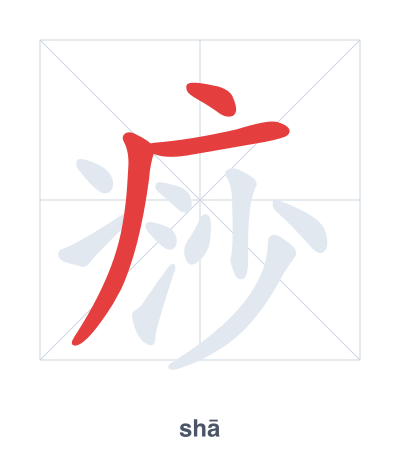
Open Hanzi Writer to see the animated stroke order and practice writing 痧 with real-time feedback.
The character 痧 (shā) is written with 12 strokes. Follow the standard Chinese stroke order: top to bottom, left to right, outside before inside. The radical 疒 is one of its key components.
Practice the correct stroke order with the Hanzi Writer app to see animated stroke-by-stroke guidance with real-time feedback.
痧 means heatstroke; petechiae.
痧 is a compound character combining the illness radical 疒 with 沙 (shā, 'sand') serving as both phonetic and semantic hint. The sand component suggests the fine, sand-like rash or petechiae associated with certain heat-related illnesses, while 疒 signals a disease condition.
💡 Memory Tip: Imagine a person (疒) covered in tiny red sand grains (沙) after collapsing from heatstroke in the desert.
中医建议他去刮痧。
zhōng yī jiàn yì tā qù guā shā
The TCM doctor suggested he try scraping (Gua Sha).
他的背上出痧了。
tā de bèi shàng chū shā le
He has red spots on his back from scraping therapy.
她买了一个新的刮痧板。
tā mǎi le yí gè xīn de guā shā bǎn
She bought a new Gua Sha tool.
Open Hanzi Writer to see the animated stroke order and practice writing 痧 with real-time feedback.
✨ Animated stroke order · Handwriting recognition · HSK-graded practice · Free to use
痧 is composed of the radical 疒 (illness) on the left and the phonetic component 沙 (shā, sand) on the right. The radical 疒 indicates that the character relates to disease or sickness, while 沙 hints at the sand-like, tiny red spots (petechiae) that appear on the skin during heatstroke or Gua Sha therapy.