褥 (rù) means "mattress; bedding" in Chinese. It has 15 strokes with the radical 衤.
Rated 4.2/5 in difficulty (advanced).
Appears in 3+ common words including 褥子 (rù zi), 被褥 (bèi rù), 床褥 (chuáng rù).
Due to its 15 strokes, Hanzi Writer's error detection shows 褥 requires focused practice — most learners need 10+ attempts for consistent accuracy.
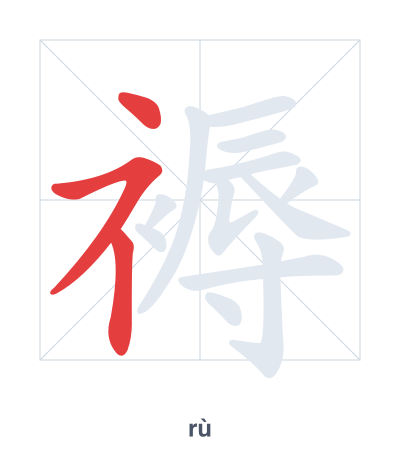
Open Hanzi Writer to see the animated stroke order and practice writing 褥 with real-time feedback.
The character 褥 (rù) is written with 15 strokes. Follow the standard Chinese stroke order: top to bottom, left to right, outside before inside. The radical 衤 is one of its key components.
Practice the correct stroke order with the Hanzi Writer app to see animated stroke-by-stroke guidance with real-time feedback.
褥 means mattress; bedding.
褥 combines the radical 衤 (cloth) with 辱 (rù, 'disgrace') as a phonetic component. The cloth radical indicates the object is made of fabric, connecting directly to the meaning of a mattress or bedding.
💡 Memory Tip: Picture a mattress (衤) that brings you disgrace (辱) because it's so lumpy and uncomfortable.
床上的褥子很软。
chuáng shàng de rù zi hěn ruǎn
The mattress pad on the bed is very soft.
我们要换新被褥。
wǒ men yào huàn xīn bèi rù
We need to change the bedding.
这套床褥很舒服。
zhè tào chuáng rù hěn shū fú
This bedding is very comfortable.
Open Hanzi Writer to see the animated stroke order and practice writing 褥 with real-time feedback.
✨ Animated stroke order · Handwriting recognition · HSK-graded practice · Free to use
The left side 衤 (yī) is the clothing radical, indicating that 褥 relates to fabric or textiles. The right side 辱 (rǔ) provides the pronunciation and originally meant "disgrace," but here it mainly acts as a phonetic component. Together, they form a character for soft bedding items made of cloth.