裰 (duō) means "to mend clothes; a long robe" in Chinese. It has 13 strokes with the radical 衤.
Rated 4.2/5 in difficulty (advanced).
Appears in 3+ common words including 直裰 (zhí duō), 补裰 (bǔ duō), 裰子 (duō zi).
Due to its 13 strokes, Hanzi Writer's error detection shows 裰 requires focused practice — most learners need 10+ attempts for consistent accuracy.
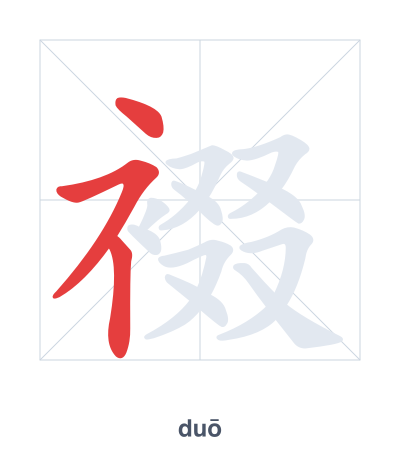
Open Hanzi Writer to see the animated stroke order and practice writing 裰 with real-time feedback.
The character 裰 (duō) is written with 13 strokes. Follow the standard Chinese stroke order: top to bottom, left to right, outside before inside. The radical 衤 is one of its key components.
Practice the correct stroke order with the Hanzi Writer app to see animated stroke-by-stroke guidance with real-time feedback.
裰 means to mend clothes; a long robe.
裰 combines the radical 衤 (clothes) with the component 叕 (to join or connect), visually depicting the act of mending fabric by stitching pieces together. Its meaning 'to mend clothes' directly arises from this combination, while 'long robe' likely derives from the extended fabric of an unhemmed garment.
💡 Memory Tip: Imagine a tailor using four needles (叕) to stitch a torn coat (衤) back into a long, flowing robe.
他穿着一件灰直裰。
tā chuān zhe yī jiàn huī zhí duō
He is wearing a gray straight-cut robe.
奶奶在补裰旧衣服。
nǎi nǎi zài bǔ duō jiù yī fú
Grandma is mending old clothes.
他穿着一件青裰子。
tā chuān zhe yī jiàn qīng duō zi
He is wearing a blue straight-cut robe.
Open Hanzi Writer to see the animated stroke order and practice writing 裰 with real-time feedback.
✨ Animated stroke order · Handwriting recognition · HSK-graded practice · Free to use
裰 is composed of the radical 衤 (clothing) on the left and the phonetic component 叕 (meaning 'connect' or 'join') on the right. The clothing radical hints that the character relates to garments, while 叕 suggests the action of joining or mending fabric, together meaning 'to mend clothes' or 'a long robe'.