裱 (biǎo) means "to mount (a painting or calligraphy)" in Chinese. It has 13 strokes with the radical 衤.
Rated 4.2/5 in difficulty (advanced).
Appears in 3+ common words including 裱画 (biǎo huà), 裱框 (biǎo kuāng), 装裱 (zhuāng biǎo).
Due to its 13 strokes, Hanzi Writer's error detection shows 裱 requires focused practice — most learners need 10+ attempts for consistent accuracy.
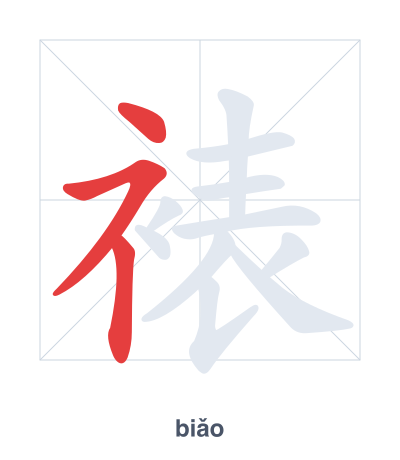
Open Hanzi Writer to see the animated stroke order and practice writing 裱 with real-time feedback.
The character 裱 (biǎo) is written with 13 strokes. Follow the standard Chinese stroke order: top to bottom, left to right, outside before inside. The radical 衤 is one of its key components.
Practice the correct stroke order with the Hanzi Writer app to see animated stroke-by-stroke guidance with real-time feedback.
裱 means to mount (a painting or calligraphy).
裱 combines the clothing radical 衤 (fabric) with 表 (surface), reflecting the process of applying a fabric backing to the surface of a painting or calligraphy to mount it.
💡 Memory Tip: Imagine a painter using a cloth (衤) to smooth and secure the surface (表) of a scroll while mounting it.
我要去店里裱画。
wǒ yào qù diàn lǐ biǎo huà
I'm going to the shop to have a painting framed.
这张照片已经裱框了。
zhè zhāng zhào piān yǐ jīng biǎo kuāng le
This photo has already been framed.
这幅画装裱得很漂亮。
zhè fú huà zhuāng biǎo dé hěn piào liàng
This painting is beautifully mounted.
Open Hanzi Writer to see the animated stroke order and practice writing 裱 with real-time feedback.
✨ Animated stroke order · Handwriting recognition · HSK-graded practice · Free to use
裱 consists of the radical 衤 (clothing) on the left and the component 表 (surface, external) on the right. The clothing radical hints at the use of cloth or fabric in mounting artwork, while 表 provides the pronunciation biǎo and suggests covering the surface of a painting.