厷 (gōng) means "grand; big (archaic)" in Chinese. It has 4 strokes with the radical 厶.
Rated 2.4/5 in difficulty (moderate).
Appears in 3+ common words including 厷大 (gōng dà), 厷志 (gōng zhì), 厷才 (gōng cái).
Hanzi Writer's stroke validation shows learners typically need 5-8 attempts to write 厷 with correct proportion and order.
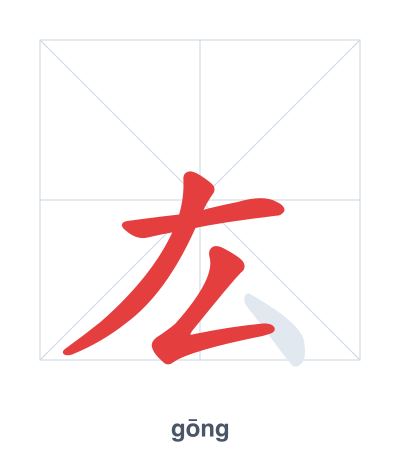
Open Hanzi Writer to see the animated stroke order and practice writing 厷 with real-time feedback.
The character 厷 (gōng) is written with 4 strokes. Follow the standard Chinese stroke order: top to bottom, left to right, outside before inside. The radical 厶 is one of its key components.
Practice the correct stroke order with the Hanzi Writer app to see animated stroke-by-stroke guidance with real-time feedback.
厷 means grand; big (archaic).
| Character | 厷 |
| Pinyin | gōng (gong) |
| Meaning | grand; big (archaic) |
| Strokes | 4 |
| Radical | 厶 |
| Difficulty | 2.4/5 |
厷 originally depicted a human upper arm (肱) in oracle bone script, showing a curved arm with a hand. The meaning 'grand' or 'big' likely came from the arm's association with strength and power.
💡 Memory Tip: Picture a giant flexing a huge bicep (formed by the top line and curved 厶) to show off its grand size.
他的志向很厷大。
tā de zhì xiàng hěn gōng dà
His ambition is very grand.
少年要有厷志。
shào nián yào yǒu gōng zhì
Youth should have great ambitions.
他是一个厷才。
tā shì yí gè gōng cái
He is a man of great talent.
Open Hanzi Writer to see the animated stroke order and practice writing 厷 with real-time feedback.
✨ Animated stroke order · Handwriting recognition · HSK-graded practice · Free to use
厷 is composed of the radical 厶 (sī, meaning "private") on top of a horizontal line or arm-like stroke. This structure visually suggests something "private" expanded or enlarged, connecting to the archaic meaning of "grand" or "big."