厽 (lěi) means "to pile up (archaic)" in Chinese. It has 6 strokes with the radical 厶.
Rated 2.9/5 in difficulty (moderate).
Appears in 3+ common words including 厽土 (lěi tǔ), 厽块 (lěi kuài), 筑厽 (zhù lěi).
Hanzi Writer's stroke validation shows learners typically need 5-8 attempts to write 厽 with correct proportion and order.
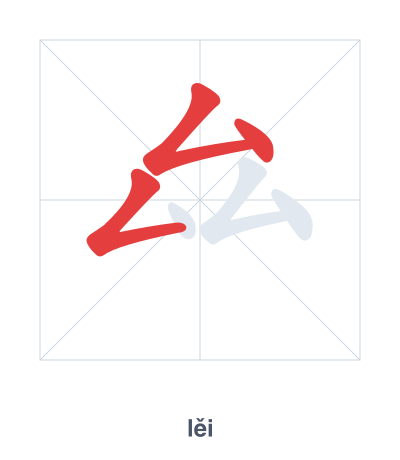
Open Hanzi Writer to see the animated stroke order and practice writing 厽 with real-time feedback.
The character 厽 (lěi) is written with 6 strokes. Follow the standard Chinese stroke order: top to bottom, left to right, outside before inside. The radical 厶 is one of its key components.
Practice the correct stroke order with the Hanzi Writer app to see animated stroke-by-stroke guidance with real-time feedback.
厽 means to pile up (archaic).
| Character | 厽 |
| Pinyin | lěi (lei) |
| Meaning | to pile up (archaic) |
| Strokes | 6 |
| Radical | 厶 |
| Difficulty | 2.9/5 |
厽 is an ancient pictograph that shows three stacked '厶' shapes, each representing a mound or pile of earth, visually depicting the concept of piling up. This character later became a component in other words like 垒 (lěi, 'to pile up, rampart').
💡 Memory Tip: Picture three little piles of dirt (厶, like private mounds) stacked one on top of another – that's your pile-up, 厽.
他在厽土。
tā zài lěi tǔ
He is piling up soil.
这里的厽块很多。
zhè lǐ de lěi kuài hěn duō
There are many earth blocks here.
工人在筑厽。
gōng rén zài zhù lěi
The worker is building a low wall.
Open Hanzi Writer to see the animated stroke order and practice writing 厽 with real-time feedback.
✨ Animated stroke order · Handwriting recognition · HSK-graded practice · Free to use
厽 is composed of three 厶 (sī) radicals stacked vertically. This stacking directly represents the idea of piling up, like stacking earth or blocks layer by layer.