厶 (sī) means "private; secret (archaic)" in Chinese. It has 2 strokes with the radical 厶.
Rated 1.9/5 in difficulty (beginner-friendly).
Appears in 3+ common words including 厶事 (sī shì), 厶有 (sī yǒu), 厶人 (sī rén).
In the Hanzi Writer app, most learners master 厶 within 3 practice attempts using stroke-by-stroke animation.
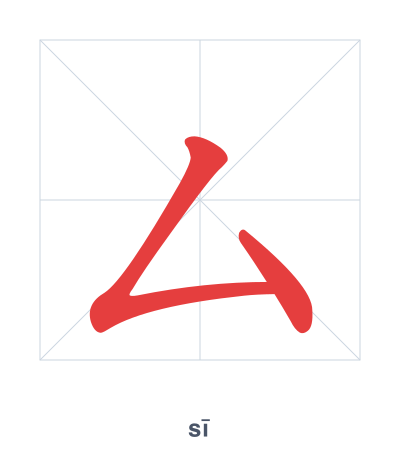
Open Hanzi Writer to see the animated stroke order and practice writing 厶 with real-time feedback.
The character 厶 (sī) is written with 2 strokes. Follow the standard Chinese stroke order: top to bottom, left to right, outside before inside. The radical 厶 is one of its key components.
Practice the correct stroke order with the Hanzi Writer app to see animated stroke-by-stroke guidance with real-time feedback.
厶 means private; secret (archaic).
| Character | 厶 |
| Pinyin | sī (si) |
| Meaning | private; secret (archaic) |
| Strokes | 2 |
| Radical | 厶 |
| Difficulty | 1.9/5 |
厶 is a pictograph of a curled or enclosed shape, originally depicting something hidden or private. In ancient scripts, it looked like a twisted loop, symbolizing that which is kept to oneself. It later became the base for 私 (private).
💡 Memory Tip: Imagine a curved hook (厶) that secretly snatches something away, hiding it from view.
这是我的厶事。
zhè shì wǒ de sī shì
This is my private matter.
这里的财产是厶有。
zhè lǐ de cái chǎn shì sī yǒu
The property here is private.
他是一个厶人。
tā shì yí gè sī rén
He is a selfish person.
Open Hanzi Writer to see the animated stroke order and practice writing 厶 with real-time feedback.
✨ Animated stroke order · Handwriting recognition · HSK-graded practice · Free to use
厶 is a simple two-stroke character that looks like a curled or hidden shape, suggesting something private or concealed. Its structure has no clear pictographic origin, but it functions as a radical meaning 'private' or 'selfish' in ancient texts. This character is rarely used alone today but appears as a component in other characters.