Hanzi Writer

How to Write 参 (cān/cēn/shēn) — Meaning “To participate; ginseng; uneven.”

cān/cēn/shēn HSK Level 2 8 strokes Radical: 厶

参 (cān/cēn/shēn) means "To participate; ginseng; uneven." in Chinese. It has 8 strokes with the radical 厶, and is HSK Level 2.

Rated 2.9/5 in difficulty (moderate).

Harder than 35% of HSK Level 2 characters.

Appears in 5+ common words including 参加 (cān jiā), 参与 (cān yù), 人参 (rén shēn).

Hanzi Writer's stroke validation shows learners typically need 5-8 attempts to write 参 with correct proportion and order.
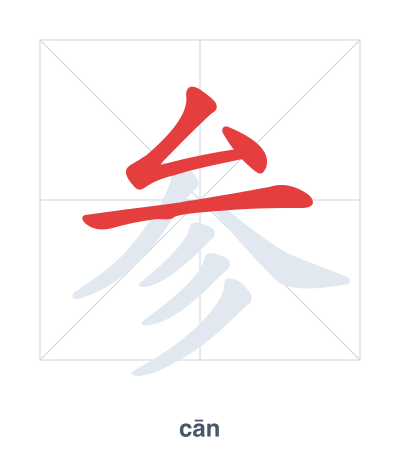
Stroke order practice for 参 - cān/cēn/shēn

Practice Writing 参 (cān/cēn/shēn)

Open Hanzi Writer to see the animated stroke order and practice writing 参 with real-time feedback.

The character (cān/cēn/shēn) is written with 8 strokes. Follow the standard Chinese stroke order: top to bottom, left to right, outside before inside. The radical is one of its key components.

Practice the correct stroke order with the Hanzi Writer app to see animated stroke-by-stroke guidance with real-time feedback.

means To participate; ginseng; uneven..

This is a polyphonic character with readings: cān, cēn, shēn.

As an HSK Level 2 character, is among the first characters beginners learn.

Character
Pinyincān / cēn / shēn (can/cen/shen)
MeaningTo participate; ginseng; uneven.
Strokes8
Radical
HSK Level2
Difficulty2.9/5

In ancient oracle bone script, 参 depicted three stars above a person, representing the Orion constellation's three-star belt. Over time, it extended to mean 'to participate' (as stars join together) and 'ginseng' (a root with three-pronged shape). The modern form combines 厶 (private) and 彡 (three strokes), hinting at three elements coming together.

💡 Memory Tip: Picture three people (彡) sneaking into a private (厶) meeting to participate.

cān jiā
To join; to attend; to participate.
cān yù
To participate in; to get involved in.
rén shēn
Ginseng
hǎi shēn
Sea cucumber
cēn cī
Uneven; irregular

我报名参加了下个月举行的校园运动会。

wǒ bào míng cān jiā le xià gè yuè jǔ xíng de xiào yuán yùn dòng huì

I signed up for the school sports meet held next month.

每个人都应当积极参与到社区建设中来。

měi gè rén dōu yīng dāng jī jí cān yù dào shè qū jiàn shè zhōng lái

Everyone should actively participate in community building.

爷爷经常用名贵的人参来泡酒喝,调理身体。

yé yé jīng cháng yòng míng guì de rén shēn lái pào jiǔ hē tiáo lǐ shēn tǐ

Grandpa often uses precious ginseng to infuse wine to improve his health.

这里的海鲜餐厅以烹饪海参而闻名。

zhè lǐ de hǎi xiān cān tīng yǐ pēng rèn hǎi shēn ér wén míng

The seafood restaurants here are famous for cooking sea cucumbers.

Character Pinyin Strokes Radical
(current) cān / cēn / shēn 8
lěi 6
xiàn 7
zhuān 8
Stroke order practice for 参 - cān/cēn/shēn

Practice Writing 参 (cān/cēn/shēn)

Open Hanzi Writer to see the animated stroke order and practice writing 参 with real-time feedback.

✨ Animated stroke order · Handwriting recognition · HSK-graded practice · Free to use

Frequently Asked Questions about 参

参 is made up of three parts: the top radical 厶 (meaning 'private' or 'self'), a middle part 大 (meaning 'big'), and a bottom part 彡 (three slanted strokes, often associated with hair or decoration). Together, these components suggest the idea of 'joining together' or 'adding many elements,' which connects to the meanings 'to participate' and 'ginseng' (a many-rooted herb). The structure does not give a direct literal meaning but helps recognize the character visually.

More HSK Level 2 Characters

Characters with Radical 厶

Other 8-Stroke Characters