厹 (róu) means "spear; to trample (archaic)" in Chinese. It has 4 strokes with the radical 厶.
Rated 2.4/5 in difficulty (moderate).
Appears in 3+ common words including 厹矛 (róu máo), 厹由 (róu yóu), 厹厹 (róu róu).
Hanzi Writer's stroke validation shows learners typically need 5-8 attempts to write 厹 with correct proportion and order.
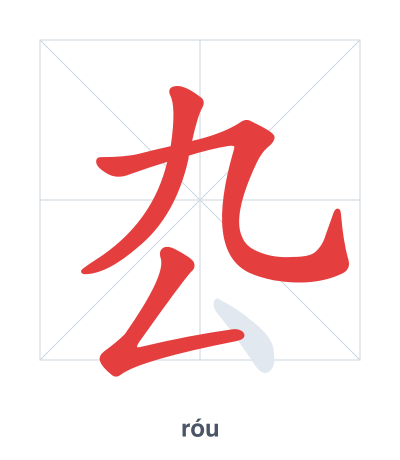
Open Hanzi Writer to see the animated stroke order and practice writing 厹 with real-time feedback.
The character 厹 (róu) is written with 4 strokes. Follow the standard Chinese stroke order: top to bottom, left to right, outside before inside. The radical 厶 is one of its key components.
Practice the correct stroke order with the Hanzi Writer app to see animated stroke-by-stroke guidance with real-time feedback.
厹 means spear; to trample (archaic).
| Character | 厹 |
| Pinyin | róu (rou) |
| Meaning | spear; to trample (archaic) |
| Strokes | 4 |
| Radical | 厶 |
| Difficulty | 2.4/5 |
This character originally depicted a spear, with the upper part (九) representing a barbed or curved blade and the lower part (厶) representing a handle or grip. In ancient oracle bone scripts, it was a pictograph of a weapon used for thrusting, later also taking on the meaning of trampling underfoot.
💡 Memory Tip: Imagine the top '九' as a spearhead with nine sharp barbs, and the bottom '厶' as a private foot that tramples the weapon into the ground.
战士拿着一把厹矛。
zhàn shì ná zhe yī bǎ róu máo
The soldier is holding a three-pronged spear.
这里的厹由很多。
zhè lǐ de róu yóu hěn duō
There are many ancient spears here.
它的样子厹厹的。
tā de yàng zi róu róu de
It has a spear-like or moving appearance.
Open Hanzi Writer to see the animated stroke order and practice writing 厹 with real-time feedback.
✨ Animated stroke order · Handwriting recognition · HSK-graded practice · Free to use
厹 is composed of the radical 厶 on top and the character 九 (nine) below. The meaning "spear" does not come directly from these parts, but the shape suggests a weapon with a triangular tip (厶) and a long shaft (九). This structure is purely visual, as the character is archaic.