圊 (qīng) means "latrine / toilet" in Chinese. It has 11 strokes with the radical 囗.
Rated 4.2/5 in difficulty (advanced).
Appears in 3+ common words including 圊厕 (qīng cè), 圊溷 (qīng hùn), 圊肥 (qīng féi).
Due to its 11 strokes, Hanzi Writer's error detection shows 圊 requires focused practice — most learners need 10+ attempts for consistent accuracy.
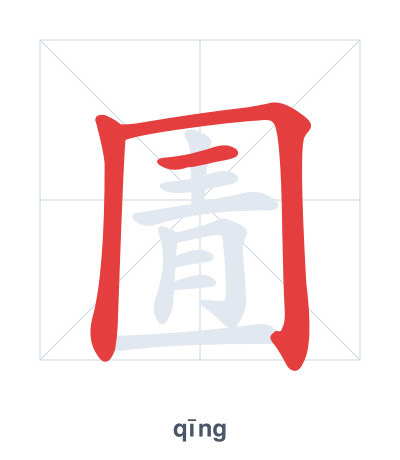
Open Hanzi Writer to see the animated stroke order and practice writing 圊 with real-time feedback.
The character 圊 (qīng) is written with 11 strokes. Follow the standard Chinese stroke order: top to bottom, left to right, outside before inside. The radical 囗 is one of its key components.
Practice the correct stroke order with the Hanzi Writer app to see animated stroke-by-stroke guidance with real-time feedback.
圊 means latrine / toilet.
The character 圊 combines the radical 囗 (enclosure) with 青 (qīng, meaning green or blue), which serves as a phonetic component. Historically, toilets were built as enclosed spaces, often located in a separate area, and the green color may symbolize the waste or the secluded, unkempt nature of the place.
💡 Memory Tip: Picture a green (青) outhouse enclosed (囗) by a fence, where you quickly go in and out to avoid the smell.
圊厕在房子后面。
qīng cè zài fáng zi hòu miàn
The toilet is behind the house.
这里有一个旧圊溷。
zhè lǐ yǒu yí gè jiù qīng hùn
There is an old latrine here.
农民在田里用圊肥。
nóng mín zài tián lǐ yòng qīng féi
Farmers are using night soil in the field.
Open Hanzi Writer to see the animated stroke order and practice writing 圊 with real-time feedback.
✨ Animated stroke order · Handwriting recognition · HSK-graded practice · Free to use
The character 圊 combines the outer radical 囗 (enclosure) with the inner component 青 (qīng, green or blue). The enclosure 囗 suggests a confined space, and 青 provides the pronunciation. Together, they form a character meaning 'latrine' or 'toilet' — a specific enclosed area.