擒 (qín) means "to capture; to seize" in Chinese. It has 15 strokes with the radical 扌.
Rated 4.2/5 in difficulty (advanced).
Appears in 3+ common words including 擒拿 (qín ná), 擒获 (qín huò), 生擒 (shēng qín).
Due to its 15 strokes, Hanzi Writer's error detection shows 擒 requires focused practice — most learners need 10+ attempts for consistent accuracy.
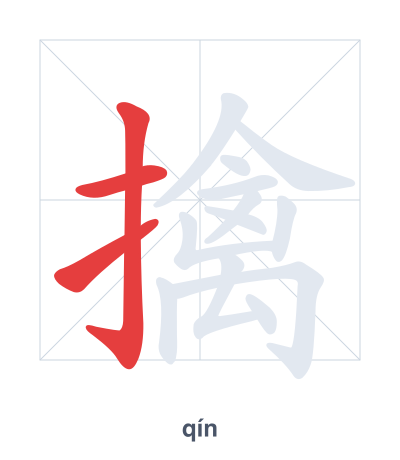
Open Hanzi Writer to see the animated stroke order and practice writing 擒 with real-time feedback.
The character 擒 (qín) is written with 15 strokes. Follow the standard Chinese stroke order: top to bottom, left to right, outside before inside. The radical 扌 is one of its key components.
Practice the correct stroke order with the Hanzi Writer app to see animated stroke-by-stroke guidance with real-time feedback.
擒 means to capture; to seize.
The character 擒 combines the hand radical 扌 (action of using hands) with 禽 (qín, meaning 'bird' or 'prey'), which also gives the sound. Originally, 禽 referred to a bird or animal caught in a trap, so together 擒 depicts the act of using one's hand to seize or capture prey.
💡 Memory Tip: Picture your hand (扌) snatching a bird (禽) out of the air to capture it.
警察学会了擒拿术。
jǐng chá xué huì le qín ná shù
The police learned grappling and arrest techniques.
小偷被当场擒获了。
xiǎo tōu bèi dāng chǎng qín huò le
The thief was caught on the spot.
士兵生擒了敌人。
shì bīng shēng qín le dí rén
The soldier captured the enemy alive.
Open Hanzi Writer to see the animated stroke order and practice writing 擒 with real-time feedback.
✨ Animated stroke order · Handwriting recognition · HSK-graded practice · Free to use
The left side of 擒 is 扌, which represents a hand or action. The right side is 禽 (qín, meaning 'bird' or 'fowl'), which gives the sound and also suggests catching a bird. Together, the character conveys the idea of using your hand to seize or capture something.