谯 (qiáo) means "to blame; lookout tower" in Chinese. It has 14 strokes with the radical 讠.
Rated 3.9/5 in difficulty (challenging).
Appears in 3+ common words including 谯楼 (qiáo lóu), 姓谯 (xìng qiáo), 谯呵 (qiáo hē).
Due to its 14 strokes, Hanzi Writer's error detection shows 谯 requires focused practice — most learners need 10+ attempts for consistent accuracy.
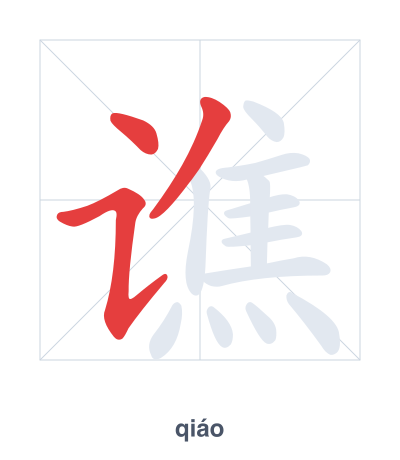
Open Hanzi Writer to see the animated stroke order and practice writing 谯 with real-time feedback.
The character 谯 (qiáo) is written with 14 strokes. Follow the standard Chinese stroke order: top to bottom, left to right, outside before inside. The radical 讠 is one of its key components.
Practice the correct stroke order with the Hanzi Writer app to see animated stroke-by-stroke guidance with real-time feedback.
谯 means to blame; lookout tower.
谯 combines the speech radical 讠 with 焦 (burnt/anxious), reflecting a lookout tower where guards shout warnings or blame. The component 焦 provides the phonetic element while the radical indicates speech-related actions.
💡 Memory Tip: On the lookout tower, a guard shouts blame (讠) at a bird that is on fire (焦).
城门上有一个谯楼。
chéng mén shàng yǒu yí gè qiáo lóu
There is a watchtower on the city gate.
我的同学姓谯。
wǒ de tóng xué xìng qiáo
My classmate's surname is Qiao.
他受到了老师的谯呵。
tā shòu dào le lǎo shī de qiáo hē
He was reprimanded by the teacher.
Open Hanzi Writer to see the animated stroke order and practice writing 谯 with real-time feedback.
✨ Animated stroke order · Handwriting recognition · HSK-graded practice · Free to use
The character 谯 is composed of the radical 讠 (speech) on the left and 焦 (qiáo) on the right. The speech radical gives the meaning related to speaking, like 'to blame,' while 焦 provides the pronunciation and originally meant 'scorch,' but in 谯 it acts mainly as a phonetic component. The meaning 'lookout tower' comes from the compound word 谯楼, not from the character itself.