憔 (qiáo) means "haggard; withered" in Chinese. It has 15 strokes with the radical 忄.
Rated 4.2/5 in difficulty (advanced).
Appears in 3+ common words including 憔悴 (qiáo cuì), 憔悴不堪 (qiáo cuì bù kān), 容颜憔悴 (róng yán qiáo cuì).
Due to its 15 strokes, Hanzi Writer's error detection shows 憔 requires focused practice — most learners need 10+ attempts for consistent accuracy.
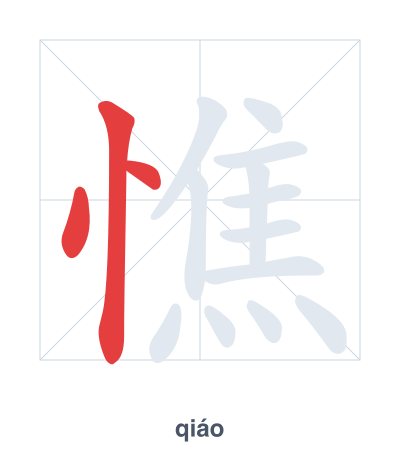
Open Hanzi Writer to see the animated stroke order and practice writing 憔 with real-time feedback.
The character 憔 (qiáo) is written with 15 strokes. Follow the standard Chinese stroke order: top to bottom, left to right, outside before inside. The radical 忄 is one of its key components.
Practice the correct stroke order with the Hanzi Writer app to see animated stroke-by-stroke guidance with real-time feedback.
憔 means haggard; withered.
The character 憔 combines the heart radical (忄) with 焦 (jiāo, meaning 'scorched' or 'burnt'), suggesting a heart that feels burnt out or withered, which reflects the state of being haggard or exhausted.
💡 Memory Tip: Picture a heart (忄) that has been burnt (焦) by worry until it shrivels into a haggard, wrinkled shape.
她的脸色看起来很憔悴。
tā de liǎn sè kàn qǐ lái hěn qiáo cuì
Her complexion looks very haggard.
他最近累得憔悴不堪。
tā zuì jìn lèi dé qiáo cuì bù kān
He is so tired lately that he looks haggard.
别让自己容颜憔悴。
bié ràng zì jǐ róng yán qiáo cuì
Don't let yourself look haggard.
Open Hanzi Writer to see the animated stroke order and practice writing 憔 with real-time feedback.
✨ Animated stroke order · Handwriting recognition · HSK-graded practice · Free to use
憔 combines the heart radical 忄 on the left with 焦 (jiāo, meaning 'burnt' or 'scorched') on the right. The heart radical indicates an emotional or mental state, while 焦 suggests something dried up or burned, together conveying a heart that feels withered or exhausted—hence 'haggard.'