愫 (sù) means "Sincere feelings; sentiment." in Chinese. It has 13 strokes with the radical 忄.
Rated 4.2/5 in difficulty (advanced).
Appears in 3+ common words including 情愫 (qíng sù), 衷愫 (zhōng sù), 诚愫 (chéng sù).
Due to its 13 strokes, Hanzi Writer's error detection shows 愫 requires focused practice — most learners need 10+ attempts for consistent accuracy.
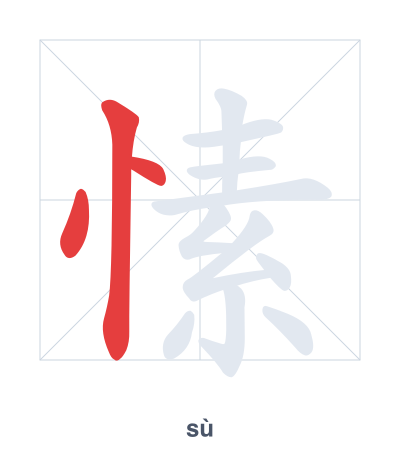
Open Hanzi Writer to see the animated stroke order and practice writing 愫 with real-time feedback.
The character 愫 (sù) is written with 13 strokes. Follow the standard Chinese stroke order: top to bottom, left to right, outside before inside. The radical 忄 is one of its key components.
Practice the correct stroke order with the Hanzi Writer app to see animated stroke-by-stroke guidance with real-time feedback.
愫 means Sincere feelings; sentiment..
This character combines the heart radical (忄) with 素 (sù), which originally depicted unbleached silk, symbolizing plainness and authenticity. Together, they suggest emotions that are pure, unembellished—true feelings from the heart.
💡 Memory Tip: Picture a heart (忄) woven from plain white silk (素) that glows with honest, unspoken sentiment.
他表达了内心的情愫。
tā biǎo dá le nèi xīn de qíng sù
He expressed his inner feelings.
这是我的真实衷愫。
zhè shì wǒ de zhēn shí zhōng sù
These are my true feelings.
他的话语充满诚愫。
tā de huà yǔ chōng mǎn chéng sù
His words were full of sincerity.
Open Hanzi Writer to see the animated stroke order and practice writing 愫 with real-time feedback.
✨ Animated stroke order · Handwriting recognition · HSK-graded practice · Free to use
愫 combines the heart radical 忄 (xīn) on the left with 素 (sù, meaning 'plain' or 'white silk') on the right. The heart symbol indicates emotions, while 素 suggests purity and simplicity, together conveying the idea of sincere and untainted feelings.